
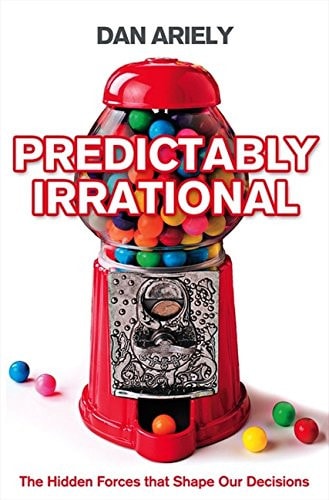
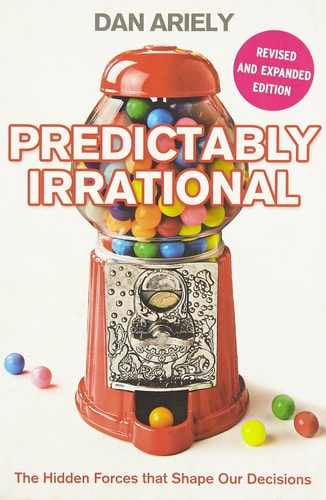
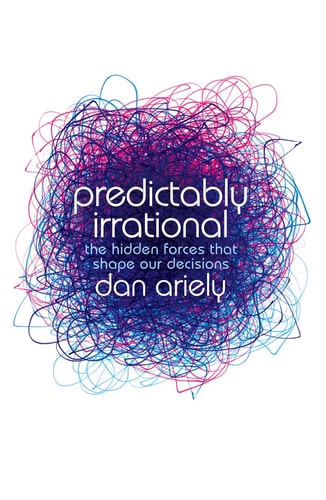
Predictably Irrational: The Hidden Forces that Shape Our Decisions
0
0
As an Amazon Associate and affiliate partner, Menrva Books earns from qualifying purchases. Learn more
Author Description
Why do our headaches persist after taking a one-cent aspirin but disappear when we take a 50-cent aspirin?Why does recalling the Ten Commandments reduce our tendency to lie, even when we couldn't possibly be caught?Why do we splurge on a lavish meal but cut coupons to save twenty-five cents on a can of soup?Why do we go back for second helpings at the unlimited buffet, even when our stomachs are already full?And how did we ever start spending $4.15 on a cup of coffee when, just a few years ago, we used to pay less than a dollar?When it comes to making decisions in our lives, we think we're in control. We think we're making smart, rational choices. But are we?In a series of illuminating, often surprising experiments, MIT behavioral economist Dan Ariely refutes the common assumption that we behave in fundamentally rational ways. Blending everyday experience with groundbreaking research, Ariely explains how expectations, emotions, social norms, and other invisible, seemingly illogical forces skew our reasoning abilities.Not only do we make astonishingly simple mistakes every day, but we make the same "types" of mistakes, Ariely discovers. We consistently overpay, underestimate, and procrastinate. We fail to understand the profound effects of our emotions on what we want, and we overvalue what we already own. Yet these misguided behaviors are neither random nor senseless. They're systematic and predictable--making us "predictably" irrational.From drinking coffee to losing weight, from buying a car to choosing a romantic partner, Ariely explains how to break through these systematic patterns of thought to make better decisions. "Predictably Irrational" will change the way we interact with the world--one small decision at a time.
Menrva's Summary
THE THESIS
This book investigates the core question of why human beings consistently make irrational decisions despite the common assumption that we act in our own best interests. Dan Ariely, a professor of behavioral economics at MIT, utilizes his extensive background in experimental psychology to challenge the traditional economic model of the rational agent. By presenting a series of controlled experiments, he demonstrates that our choices are frequently influenced by invisible, systematic forces such as social norms, emotional states, and cognitive biases. The book argues that because these patterns of irrationality are consistent, they can be identified, understood, and ultimately managed to improve our decision-making processes.
THE SCOPE MAP
What You Will Find
- Analysis of cognitive biases including the endowment effect, procrastination, and the influence of social norms.
- Experimental data derived from behavioral economics studies conducted in academic and real-world settings.
- Practical frameworks for identifying systematic errors in daily life, such as spending habits and personal health choices.
- Evidence-based explanations for why humans overvalue possessions and struggle with self-control in the face of immediate gratification.
THE AUTHORITY PERSPECTIVE
This work is widely regarded as a foundational text in popular behavioral economics, praised for its ability to translate complex academic research into accessible, everyday observations. The framing suggests a highly readable introduction to the field that successfully bridges the gap between rigorous scientific inquiry and practical application for the general reader.
Page Count:
304
Publication Date:
2008-02-19
Publisher:
HarperCollins Publishers
ISBN-10:
0007307438
ISBN-13:
9780007307432
Self-help
Psychology
Personal Transformation
Decision Making
Counseling Psychology
Self Help
Medical Books
Economics
Parenting & Relationships
Psychology
Sociology
Consumer Behavior
Community Tags
Other Editions(3)
Similar Books






Reader Comments
Share Your Thoughts
No comments yet. Be the first to share your thoughts!