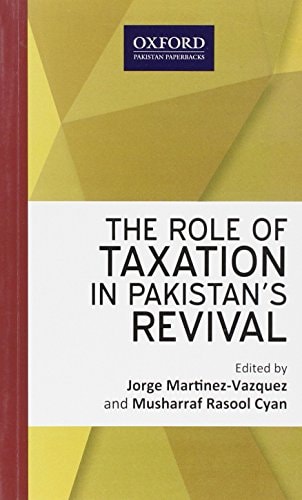
The Role of Taxation in Pakistan's Revival
0
0
As an Amazon Associate and affiliate partner, Menrva Books earns from qualifying purchases. Learn more
Author Description
The tax system of Pakistan continues to under-perform, in particular, in its ability to raise adequate revenues. The bases of the most important taxes, such as Personal and Corporate Income Tax and the General Sales Tax (GST), continue to be narrow and the level of tax evasion remains high. Moreover, in recent years, the Tax-to-GDP (Gross Domestic Product) ratio has seen a substantial decline. On the other hand, most of the macroeconomic fiscal adjustment in recent years has been on the expenditure side of the budget. The country's need for spending on social services such as education, health, and capital infrastructure are likely to increase in the near future as governments pursue a strategy of sustained economic growth. Most political manifestoes brought forward by political parties spell out major expenditure programmes while expressing a desire to increase tax collection. To reach the desired taxation level in Pakistan, an in-depth policy reforms programme needs to be formulated by policymakers. This will require a detailed analysis of tax structures and tax administration. An attempt has been made in this book to provide the necessary analysis.
Menrva's Summary
THE THESIS
This book investigates the structural failures of Pakistan's tax system and proposes a comprehensive reform framework to address the country's declining revenue-to-GDP ratio. Jorge Martinez-Vazquez and Musharraf Rasool Cyan utilize their expertise in public finance to evaluate the current fiscal landscape, characterized by narrow tax bases and high evasion rates. The authors argue that sustainable economic growth and increased social spending require a fundamental shift in both tax policy and administrative efficiency. By analyzing existing fiscal data, they provide a roadmap for policymakers to align revenue collection with national development goals.
THE SCOPE MAP
What You Will Find
- Analysis of personal and corporate income tax structures.
- Evaluation of the General Sales Tax (GST) and its performance.
- Assessment of the relationship between fiscal adjustment and expenditure-side budgeting.
- Proposed policy reform strategies for improving tax administration and compliance.
THE AUTHORITY PERSPECTIVE
Experts recognize this work as a critical technical resource for understanding the fiscal challenges facing developing economies. Readers frequently note the academic density of the prose, which serves as a foundational text for policymakers and students of South Asian economic development.
Page Count:
700
Publication Date:
2015-12-27
Publisher:
Oxford University Press
ISBN-10:
0199401152
ISBN-13:
9780199401154
Economics
Pakistan
Public Policy
Fiscal Policy
Taxation
Finance
Community Tags
Similar Books