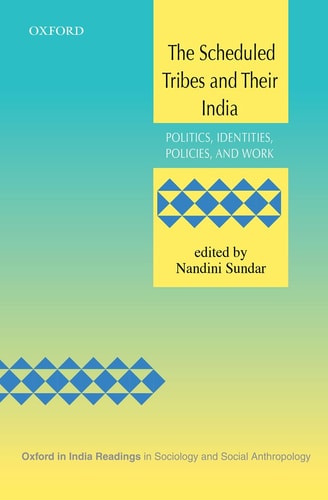
The Scheduled Tribes and Their India: Politics, Identities, Policies, and Work
0
0
As an Amazon Associate and affiliate partner, Menrva Books earns from qualifying purchases. Learn more
Author Description
A people in need of quick modernization and mainstreaming, or a powerful defense against the advancing march of capitalist growth---these are the two most prominent and stereotypical images of Adivasis in contemporary India, and both do grave injustice to the ground realities. The category Scheduled Tribes, which is purely an administrative category, and does not reflect the immense diversity among the 500 different communities of tribals in India, comprising 8.6 per cent of Indias population, has acquired over a period of time, a distinct political and discursive salience. This collection of essays, divided in three parts, brings together a range of predominantly sociological and anthropological but broadly social science writing that reflects on and illuminates the jungle of dilemmas and conflicts that the scheduled tribes face as they navigate their way through everyday life. It highlights the enormity of social, cultural, linguistic, and politico-economic diversity among the so-called Scheduled Tribes in India, and aims to provide an intellectual platform for an engagement between the scheduled tribes and their India, as also to map the state of current sociological/anthropological writing and debate on the scheduled tribes.
Menrva's Summary
THE THESIS
This collection investigates the complex intersection of administrative categorization, political identity, and the lived realities of India's Scheduled Tribes. Editors Nandini Sundar and T. N. Madan compile a rigorous selection of sociological and anthropological essays to challenge the reductive stereotypes that frame Adivasi communities as either obstacles to development or subjects in need of modernization. By analyzing the socio-economic and cultural diversity of these populations, the volume provides a critical framework for understanding the ongoing tensions between state policy and tribal autonomy.
THE SCOPE MAP
What You Will Find
- A critical examination of the administrative category of 'Scheduled Tribes' and its impact on identity formation.
- Analysis of the political and discursive salience of tribal communities within the broader Indian state.
- A multi-disciplinary synthesis of sociological and anthropological research covering over 500 distinct communities.
- Exploration of the dilemmas and conflicts arising from the intersection of capitalist growth and traditional tribal life.
THE AUTHORITY PERSPECTIVE
Scholars and students of South Asian studies frequently cite this volume as a foundational text for understanding the complexities of tribal identity in modern India. Experts highlight the collection for its ability to bridge the gap between academic theory and the practical, everyday challenges faced by Adivasi populations.
Page Count:
650
Publication Date:
2016-07-26
Publisher:
Oxford University Press
ISBN-10:
0199459711
ISBN-13:
9780199459711
Anthropology
Social Science
India_scheduled Tribes
Sociology
India
Community Tags
Similar Books