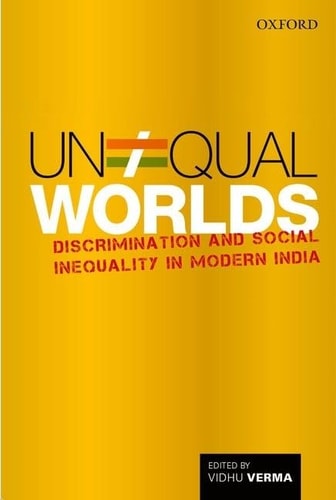
Unequal Worlds: Discrimination and Social Inequality in Modern India
0
0
As an Amazon Associate and affiliate partner, Menrva Books earns from qualifying purchases. Learn more
Author Description
In today's world social inequalities are diverse and intricate, and they are magnified by different kinds of discrimination. This volume takes up the question of social discrimination and group disadvantage of Dalits in India while also taking into account newer kinds of discrimination. The essays analyze conceptions of equality central to legislation in redressing previous discrimination in society and the discourses that have emerged around it in modern India. The Indian government and judiciary have been involved, through constitutional provisions and legal judgments, in abolishing caste discrimination. Despite efforts by the government, equality of opportunity remains an elusive ideal and several bases of discrimination continue to subvert a concern with formal and substantive equality. The promise of equality provisions and the struggle against caste discrimination are contradicted by the existence of newer kinds of social inequalities arising out of income, wealth, occupation, education, power and skills. This work specifically sets out to explore contemporary manifestations of discrimination that persist in our society through institutions and through norms and practices that define the terms on which certain social groups continue to be excluded.
Menrva's Summary
THE THESIS
This volume investigates the persistence of social discrimination and group disadvantage in modern India, questioning why constitutional and legal efforts to achieve equality have failed to eliminate systemic exclusion. Vidhu Verma, a scholar of political theory and social justice, synthesizes legal analysis with sociological inquiry to examine the gap between formal legislative equality and the reality of social stratification. The book argues that while caste-based discrimination remains a primary concern, new forms of inequality rooted in economic status, occupation, and education have emerged to further marginalize vulnerable groups.
THE SCOPE MAP
What You Will Find
- Analysis of constitutional provisions and judicial interventions regarding caste discrimination.
- Examination of contemporary socioeconomic drivers of inequality including income, wealth, and education.
- Case studies on the institutional mechanisms that perpetuate group exclusion.
- Evaluation of the effectiveness of state-led redressal policies in the Indian context.
THE AUTHORITY PERSPECTIVE
Scholars and policy analysts recognize this work as a critical contribution to the study of Indian social stratification and democratic governance. Readers frequently note the academic rigor of the text, which provides a comprehensive framework for understanding the intersection of law and social practice.
Page Count:
384
Publication Date:
2015-09-30
Publisher:
Oxford University Press
ISBN-10:
0199453284
ISBN-13:
9780199453283
India
Sociology
Human rights
Discrimination
Community Tags
Similar Books