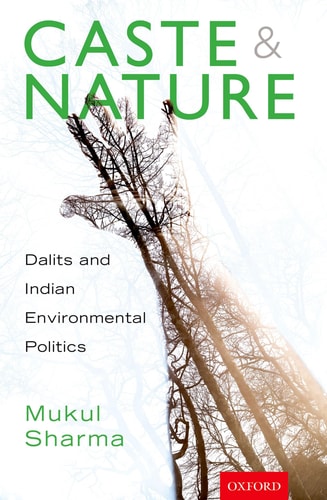
Caste and Nature: Dalits and Indian Environmental Politics
0
0
As an Amazon Associate and affiliate partner, Menrva Books earns from qualifying purchases. Learn more
Author Description
Rarely do Indian environmental discourses examine nature through the lens of caste. Whereas nature is considered as universal and inherent, caste is understood as a constructed historical and social entity. Mukul Sharma shows how caste and nature are intimately connected. He compares Dalit meanings of environment to ideas and practices of neo-Brahmanism and certain mainstreams of environmental thought. Showing how Dalit experiences of environment are ridden with metaphors of pollution, impurity, and dirt, the author is able to bring forth new dimensions on both environment and Dalits, without valourizing the latter's standpoint.Rather than looking for a coherent understanding of their ecology, the book explores the diverse and rich intellectual resources of Dalits, such as movements, songs, myths, memories, and metaphors around nature. These reveal their quest to define themselves in caste-ridden nature and building a form of environmentalism free from the burdens of caste. The Dalits also pose a critical challenge to Indian environmentalism, which has, until now, marginalized such linkages between caste and nature.
Menrva's Summary
THE THESIS
This book investigates the intersection of caste dynamics and environmental politics in India, questioning why mainstream environmental discourse has historically ignored the role of social hierarchy in shaping human relationships with nature. Mukul Sharma, a scholar of social movements and environmental politics, utilizes a multidisciplinary approach to analyze how Dalit communities experience, conceptualize, and resist environmental marginalization. By examining the interplay between concepts of purity, pollution, and ecological access, the author argues that a truly inclusive environmentalism must address the systemic inequalities inherent in the caste system.
THE SCOPE MAP
What You Will Find
- Analysis of Dalit intellectual resources including myths, songs, and oral histories regarding nature.
- Comparative study between Dalit ecological perspectives and neo-Brahmanical environmental ideologies.
- Examination of how metaphors of pollution and impurity dictate environmental access and social exclusion.
- Critique of mainstream Indian environmental movements for their historical failure to integrate caste-based analysis.
THE AUTHORITY PERSPECTIVE
Experts recognize this work as a significant contribution to the field of political ecology for its focus on the often-overlooked connection between social stratification and environmental justice. Readers frequently note the academic density of the prose, which provides a rigorous framework for understanding the complex sociological dimensions of environmental policy in India.
Page Count:
336
Publication Date:
2018-02-28
Publisher:
Oxford University Press
ISBN-10:
0199477566
ISBN-13:
9780199477562
Politics
Caste
Sociology
Dalits
Social justice
India
Community Tags
Similar Books