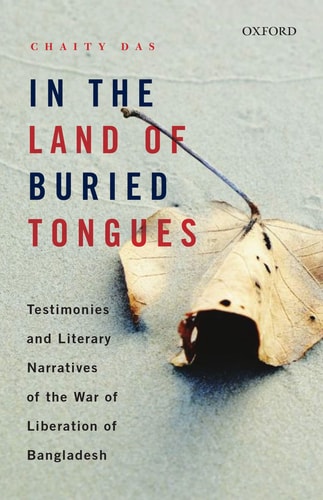
In the Land of Buried Tongues: Testimonies and Literary Narratives of the War of Liberation of Bangladesh
0
0
As an Amazon Associate and affiliate partner, Menrva Books earns from qualifying purchases. Learn more
Author Description
This book is about testimonial and fictional narratives emerging from the War of Liberation of Bangladesh in 1971. It ended when winter came but the chill persisted for long. The spectres of war were resurrected with accounts of vigilante violence against those who opposed the liberation, predominantly Urdu speakers. The assassination of top leaders of the freedom struggle and the war, the rise of military dictatorship, the execution of Mujib's killers in 2010, and the trial and execution of Razakars recently, remind one of the deep wounds of war. War literature from Bangladesh and Pakistan continues to appear in spite of officially authorized remembrance and forgetting. In placing testimonial accounts beside fiction, a complex picture of the legacy of a violent time becomes visible.Recent studies into the war have not dealt with the fund of insights provided by the fiction that commemorates the second partition of the subcontinent. In dealing with memories and spectres of suffering, fiction helps to negotiate the 'archives of silence' (Yasmin Saikia's phrase) and allows us to analyse narratives of victory and loss. In articulating the deeply gendered universe of War, the fuzzy borders between perpetrators and victims are made visible. This book argues that as writers or memoirists are compulsively drawn towards the ethical task of remembering 1971; in the gaps and slippages of these narratives the strains of nationalistic accounts begin to show. In attempts to renegotiate these spaces in the works of Akhtaruzzaman Elias, Tahmima Anam, Intizar Husain, Kamila Shamsie, and Sorayya Khan lies the evidence that a politics of possibility cannot bury the traumas of the past.
Menrva's Summary
THE THESIS
This book investigates how testimonial and fictional narratives from the 1971 Bangladesh War of Liberation challenge official nationalistic accounts and expose the enduring trauma of the conflict. Chaity Das, an academic scholar, examines the intersection of memory, literature, and political history to analyze how writers from Bangladesh and Pakistan negotiate the 'archives of silence.' By placing personal testimonies alongside literary works, the author argues that these narratives reveal the complex, often gendered, and morally ambiguous legacy of the war that official state histories frequently obscure.
THE SCOPE MAP
What You Will Find
- A comparative analysis of war literature from both Bangladesh and Pakistan.
- An examination of the 'archives of silence' regarding the 1971 conflict and its aftermath.
- Critical readings of works by authors including Akhtaruzzaman Elias, Tahmima Anam, Intizar Husain, Kamila Shamsie, and Sorayya Khan.
- An exploration of the gendered nature of war and the blurred lines between victimhood and perpetration.
THE AUTHORITY PERSPECTIVE
Scholars and critics recognize this work as a significant contribution to the study of South Asian war literature and memory politics. Readers frequently note the academic density of the prose and the author's ability to synthesize complex literary analysis with historical trauma.
Page Count:
376
Publication Date:
2017-08-03
Publisher:
Oxford University Press
ISBN-10:
0199474729
ISBN-13:
9780199474721
History
War
Literary Criticism
Educational Resources
Kindle Store
Categories
Kindle eBooks
Community Tags
Similar Books