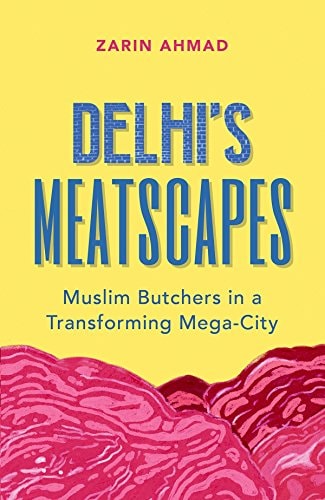
Delhi's Meatscapes: Muslim Butchers in a Transforming Mega City
0
0
As an Amazon Associate and affiliate partner, Menrva Books earns from qualifying purchases. Learn more
Author Description
This work is about the Qureshi Muslim butchers of Delhi-an endogamous group among Muslims in India, traditionally involved in the Islamic Halaal slaughtering and selling of animal meat. Ethnographic studies on Qureshi Muslims in India have been rare. The aim of this work is to add to the small and scattered literature on social diversities among Indian Muslims. It looks at the lives of an urban occupational people who are engaged in the meat sector, the commodity meat, and the socio-political, economic, and cultural spaces that meat occupies in urban areas. In doing so, the author follows the transformation of the animal to diverse commodities and their trajectory from the farm to the meat shop. The author argues that the meat sector itself has undergone significant technological changes, mechanizing many of the tasks that were earlier performed manually. This has signalled a huge socio-economic shift for butchers and as well as the meat trade. The domain of the butchers it is argued was already polarized and problematized due to the complexities of meat in the Indian religious, political, and social landscape. This study thus aims to understand and document these shifts and contextualize the changing identities of a marginalized community.
Menrva's Summary
THE THESIS
How does the modernization of the meat industry impact the socio-economic identity and cultural standing of the Qureshi Muslim butcher community in Delhi? Zarin Ahmad utilizes extensive ethnographic research to examine the Qureshi community, a group historically defined by their role in the halal meat trade. The author investigates the intersection of technological mechanization, urban development, and the complex religious politics surrounding meat consumption in India. By tracing the commodity chain from farm to shop, the text argues that these shifts have fundamentally altered the labor practices and social status of this marginalized occupational group.
THE SCOPE MAP
What You Will Find
- Detailed ethnographic documentation of the Qureshi Muslim community in Delhi.
- Analysis of the transition from manual slaughtering techniques to mechanized industrial processes.
- Examination of the socio-political and religious tensions inherent in the Indian meat trade.
- Mapping of the commodity trajectory of meat within the urban landscape of a transforming mega city.
THE AUTHORITY PERSPECTIVE
Scholars in the fields of South Asian studies and urban anthropology recognize this work as a significant contribution to the under-researched social dynamics of Indian Muslim occupational groups. Readers frequently note the academic rigor and the clarity with which the author contextualizes the intersection of labor, identity, and urban policy.
Page Count:
360
Publication Date:
2018-09-01
Publisher:
Oxford University Press
ISBN-10:
0199477809
ISBN-13:
9780199477807
Urban Studies
Meat Industry And Trade
Muslims india
Anthropology
Butchers
India
Food Studies
Sociology
Community Tags
Similar Books