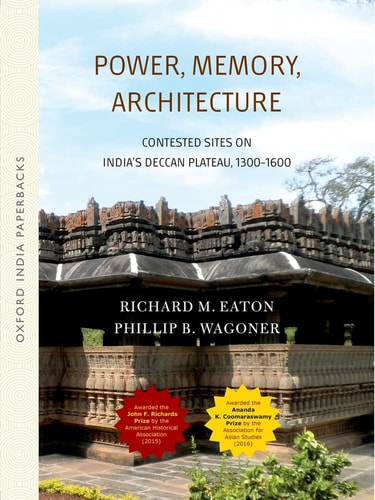
Power, Memory, Architecture: Contested Sites on India's Deccan Plateau
0
0
As an Amazon Associate and affiliate partner, Menrva Books earns from qualifying purchases. Learn more
Author Description
Most studies of the history of the early modern Deccan focus on struggles between the region's primary centers, that is, the great capital cities such as Bijapur, Vijayanagara, or Golconda. This study, by contrast, examines the political histories and material culture of smaller, fortified strongholds both on the plains and atop hills, the control of which was repeatedly contested by rival primary centers. Exceptionally high levels of conflict over such secondary centers occurred between 1300 and 1600, and especially during the turbulent sixteenth century when gunpowder technology had become widespread in the region.The authors bring two principal objectives to the enquiry. One is to explore how political power, monumental architecture, and collective memory interacted with one another in the period under study. The study's authors - one trained in history, the other in art history and archaeology - argue for systematically integrating the methodologies of history, art history, and archaeology in attempts to reconstruct the past. The study's other aim is to radically rethink the usefulness of Hindu - Muslim relations as the master key by which to interpret this period of South Asian history, and to propose instead a model informed by Sanskrit and the Persian literary traditions.
Menrva's Summary
THE THESIS
This study investigates how political power, monumental architecture, and collective memory intersected within the contested secondary strongholds of the Deccan Plateau between 1300 and 1600. Authors Richard M. Eaton and Phillip B. Wagoner, experts in history and art history respectively, utilize a multidisciplinary framework to analyze the region's material culture. By integrating historical records with archaeological evidence, they challenge traditional interpretations of South Asian history that rely solely on Hindu-Muslim relations, proposing instead a model rooted in Sanskrit and Persian literary traditions.
THE SCOPE MAP
What You Will Find
- Analysis of fortified strongholds and secondary centers on the Deccan Plateau.
- Examination of the impact of gunpowder technology on regional conflict during the sixteenth century.
- A methodological framework integrating history, art history, and archaeology.
- A critical re-evaluation of the role of Sanskrit and Persian literary traditions in shaping political identity.
THE AUTHORITY PERSPECTIVE
Scholars recognize this work as a significant contribution to the study of early modern South Asian political and material history. Readers frequently note the academic rigor and the successful synthesis of diverse disciplinary methodologies in the authors' analysis of regional power dynamics.
Page Count:
422
Publication Date:
2017-12-26
Publisher:
Oxford University Press
ISBN-10:
0199477698
ISBN-13:
9780199477692
Architecture
History
Political History
Archaeology
India - History
Art History
Deccan India
Community Tags
Similar Books