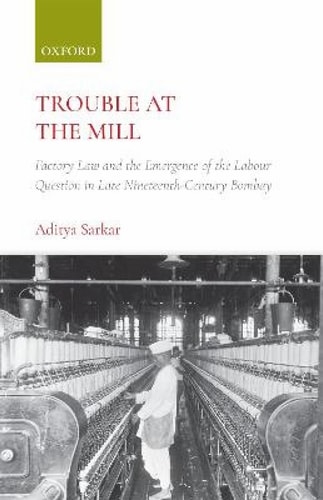
Trouble at the Mill: Factory Law and the Emergence of Labour Question in Late Nineteenth-Century Bombay
0
0
As an Amazon Associate and affiliate partner, Menrva Books earns from qualifying purchases. Learn more
Author Description
The book uses the Factory Acts of the late nineteenth century as an entry point into the early history of labour relations in India, specifically the mill industry of Bombay. It unites legal and social history in a manner which differs from most social histories of labour, and offers a new perspective on the constitution of industrial relations in colonial India. The Factory Act passed by the Government of British India in 1881 produced the first official definition of 'factories' in modern Indian history as workplaces using steam power and regularly employing over 100 workers. It imposed certain minimal restrictions upon the freedom of employers in a limited range of industrial workplaces and invested factory workers, most explicitly children, with a slim set of immunities and entitlements. In 1891, the Factory Act was amended: factories were redefined as workplaces employing over 50 workers, the upper age limit of legal 'protection' was raised, weekly holidays were established, and women mill-workers were brought within its ambit. In its own time, factory law was experienced as a minor official initiative, but it connected with some of the most potent ideological debates and political oppositions of the age. This book takes these two pieces of labour legislation as an entry point into the history of 'industrial relations' (the term did not yet exist in its present sense) in colonial India, in the last quarter of the nineteenth century combining the legal and social history which diverges from most studies of Indian workers. It identifies an emergent 'factory question' built on the problem of protective labour legislation. The cotton-mill industry of Bombay, long familiar to labour historians as one of the nodal points of modern Indian capitalism, is the principal focal point of this investigation. While this is a book about law and regulation, it is neither a legislative nor a policy history. While it is preoccupied with the history of factory legislation, it does
Menrva's Summary
THE THESIS
This book investigates how the implementation of late nineteenth-century Factory Acts in Bombay catalyzed the emergence of the 'labour question' and redefined industrial relations in colonial India. Aditya Sarkar, an expert in South Asian history, utilizes a synthesis of legal and social history to analyze how colonial legislation transformed the workplace. By examining the 1881 and 1891 Factory Acts, the author argues that these regulations were not merely administrative policies but were central to the ideological and political conflicts of the era. The study focuses on the cotton-mill industry as a primary site for understanding the shifting power dynamics between the colonial state, mill owners, and the workforce.
THE SCOPE MAP
What You Will Find
- Analysis of the 1881 and 1891 Factory Acts and their impact on industrial definitions.
- Examination of the cotton-mill industry in Bombay as a nodal point of Indian capitalism.
- Integration of legal archives with social history methodologies to track labor relations.
- Exploration of the ideological debates surrounding protective labor legislation in colonial settings.
THE AUTHORITY PERSPECTIVE
Scholars recognize this work as a significant contribution to the field of labor history for its departure from traditional policy-focused narratives. Readers frequently note the academic density of the prose and the author's ability to bridge the gap between legal frameworks and the lived experiences of industrial workers.
Page Count:
368
Publication Date:
2017-08-17
Publisher:
Oxford University Press
ISBN-10:
0199474427
ISBN-13:
9780199474424
History
Economics
Legal History
Labor history
Industrial Relations
Factory laws and legislation
Colonial India
Law india
Community Tags
Similar Books








Reader Comments
Share Your Thoughts
No comments yet. Be the first to share your thoughts!