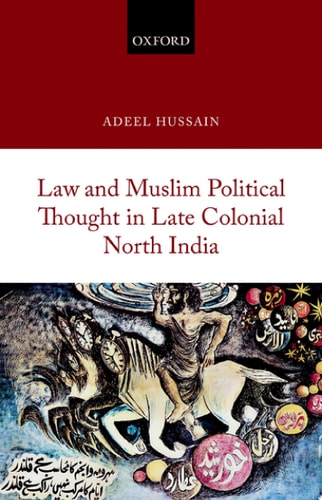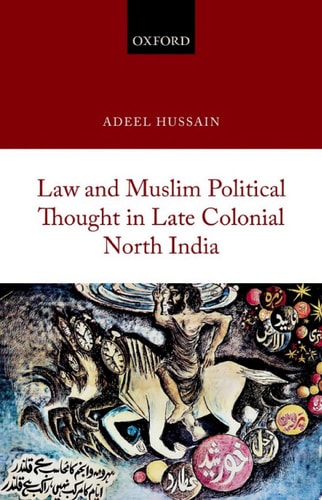
Law and Muslim Political Thought in Late Colonial North India
0
0
As an Amazon Associate and affiliate partner, Menrva Books earns from qualifying purchases. Learn more
Author Description
During the 1930s, much of the world was in severe economic and political crisis. This upheaval ushered in new ways of thinking about social and political systems. In some cases, these new ideas transformed states and empires alike. Particularly in Europe, these transformations are well-chronicled in scholarship. In academic writings on India, however, Muslim political and legal thought has gone relatively unnoticed during this eventful decade. This book fills this gap by mapping the evolution of Muslim political and legal thought from roughly 1927 to 1940. By looking at landmark court cases in tandem with the political and legal ideas of Muhammad Iqbal and Muhammad Ali Jinnah, Pakistan's founding fathers, this book highlights the more concealed ways in which Indian Muslims began to acquire a political outlook with distinctly separatist aspirations. What makes this period worthy of a separate study is that the legal antagonism between religious communities in the 1930s foreshadowed political conflicts that arose in the run-up to independence in 1947. The presented cases and thinkers reflect the possibilities and limitations of Muslim political thought in colonial India.
Menrva's Summary
THE THESIS
How did the evolution of Muslim political and legal thought in 1930s India contribute to the development of separatist aspirations leading to the partition of 1947? Adeel Hussain, a scholar of legal and political history, utilizes a comparative framework to examine the intersection of colonial jurisprudence and the intellectual contributions of Muhammad Iqbal and Muhammad Ali Jinnah. By analyzing landmark court cases alongside the writings of these figures, the author argues that legal tensions between religious communities during this decade served as a precursor to the political fractures that defined the end of British colonial rule.
THE SCOPE MAP
What You Will Find
- An analysis of Muslim political and legal thought between 1927 and 1940.
- A comparative study of judicial court cases and the political philosophies of Muhammad Iqbal and Muhammad Ali Jinnah.
- An examination of the transition from colonial legal frameworks to separatist political identity.
Scope Limits
- The study is geographically confined to North India and chronologically restricted to the 1930s.
- The book does not provide a comprehensive history of the entire Indian independence movement, focusing instead on specific legal and intellectual developments.
THE AUTHORITY PERSPECTIVE
Scholars recognize this work as a significant contribution to the study of colonial legal history and the intellectual origins of Pakistan. Readers frequently note the academic rigor and the specific focus on the intersection of jurisprudence and political theory as a valuable addition to existing literature on the period.
Page Count:
247
Publication Date:
2022-01-01
Publisher:
OUP Oxford
ISBN-10:
0192675923
ISBN-13:
9780192675927
History
Colonial India
Legal History
Asian History
Islamic Studies
Asian Studies