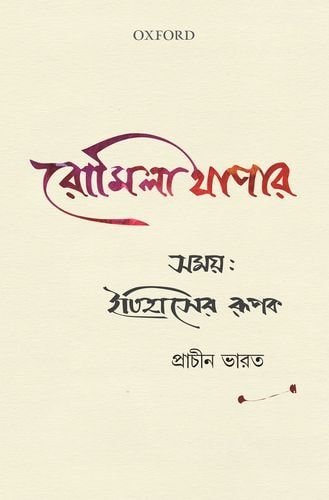
Samay: Itihaser Rupak
0
0
As an Amazon Associate and affiliate partner, Menrva Books earns from qualifying purchases. Learn more
Author Description
It has long been maintained that the only concept of time known to early India was cyclic. This in part accounts for the Indian denial of history, since a sense of history is based on linear time. This study sets the argument in the context of links between time and history. It indicates the existence of linear time in Indian texts, such as genealogies, biographies, and chronicles, where time-reckoning was recorded through generations, regnal years and eras. It is suggested that cyclic and linear time were both used, but that their functions differed. Cyclic time occurs frequently in cosmological contexts and linear time in historical sources. The author argues that historical consciousness existed in early India.
Menrva's Summary
THE THESIS
This work investigates the prevailing academic assumption that early Indian civilization lacked a linear historical consciousness due to an exclusive reliance on cyclic time. Romila Thapar, a preeminent historian of ancient India, utilizes a rigorous analysis of primary textual sources to challenge this long-standing historiographical claim. By examining the intersection of temporal concepts and historical documentation, she argues that early Indian society employed both cyclic and linear frameworks to serve distinct social and intellectual functions.
THE SCOPE MAP
What You Will Find
- Analysis of early Indian textual traditions including genealogies, biographies, and royal chronicles.
- Examination of the functional distinction between cosmological cyclic time and historical linear time.
- Evaluation of historical consciousness as evidenced by regnal years, eras, and generational record-keeping.
- A critical reassessment of the historiographical debate regarding Indian perceptions of time and history.
THE AUTHORITY PERSPECTIVE
Experts recognize this text as a significant intervention in the study of Indian historiography, providing a necessary correction to colonial-era narratives about Indian temporal perception. Readers frequently note the academic density of the prose, which requires a foundational understanding of ancient Indian textual traditions to fully grasp the author's nuanced argument.
Page Count:
94
Publication Date:
2018-01-01
Publisher:
Oxford University Press
ISBN-10:
0199485623
ISBN-13:
9780199485628
History
Philosophy
Historiography
Indian History
Community Tags
Similar Books