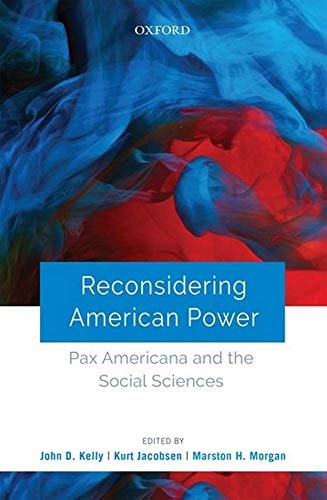
Reconsidering American Power: Pax Americana and the Social Sciences
0
0
As an Amazon Associate and affiliate partner, Menrva Books earns from qualifying purchases. Learn more
Author Description
About the Author John D. Kelly, Christian W. Mackauer Professor of Anthropology and Social Sciences, University of Chicago,Kurt Jacobsen, Research Associate in Political Science, University of Chicago,Marston H. Morgan, Member, United States Foreign ServiceJohn D. Kelly is Christian W. Mackauer Professor of Anthropology and Social Sciences at the University of Chicago and is the author of coeditor of eight books.. He does research in Fiji and in India, on topics including ritual in history, knowledge and power, semiotic and military technologies, colonialism and capitalism, decolonization and diasporas. His most recent book, Represented Communities: Fiji and World Decolonization, co-written with Martha Kaplan, concerns the constituting of nation-states out of empires. He is currently working on two other books. Laws Like Bullets, also co-authored with Martha Kaplan, concerns colonial lawgiving. Technography: Sciences in the History of Cultures, raises questions for anthropology of knowledge with a focus on the grammarians of ancient India and the engineering of Sanskrit.Kurt Jacobsen has been a research associate (lately, Associate) in Political Science at the University of Chicago since the mid-1980s. He has taught at the Center for the Study of Science, Technology and Medicine atImperial College London, Duke University, University of North Carolina at Chapel Hill, Rutgers University, University of Chicago and been a visiting scholar many times at the London School of Economics. He is the author or editor of ten other books, including Chasing Progress in the Irish Republic, Technical Fouls: Democratic Dilemmas and Technological Change, Experiencing The State (co-edited with Lloyd Rudolph), Freud's Foes, Pacification and Its Discontents, and International Politics and Inner Worlds. He is book review editor at Logos: A Journal of Modern Society & Culture, coeditor of Free Associations: Psychoanalysis, Groups, Media and Politics (UK), a contributor to many periodicals
Menrva's Summary
THE THESIS
This work investigates the intersection of American geopolitical hegemony and the evolution of the social sciences in the post-World War II era. The authors, drawing on their backgrounds in anthropology, political science, and foreign service, analyze how the concept of 'Pax Americana' has influenced academic inquiry and institutional knowledge production. They argue that the social sciences have often functioned as both a tool for and a subject of American power, necessitating a critical re-evaluation of the relationship between intellectual frameworks and global dominance.
THE SCOPE MAP
What You Will Find
- Historical analysis of the post-1945 international order and the rise of American global influence.
- Examination of how social science disciplines have adapted to or facilitated state-building and foreign policy objectives.
- Theoretical frameworks regarding the role of knowledge production in maintaining imperial or hegemonic structures.
- Case studies illustrating the practical application of social science research within the context of international relations and military technology.
THE AUTHORITY PERSPECTIVE
Experts recognize this text as a significant interdisciplinary critique of the institutionalization of American power within academia. Scholars frequently note the dense, analytical prose that challenges conventional narratives regarding the neutrality of social science research in the modern era.
Page Count:
540
Publication Date:
2020-03-03
Publisher:
Oxford University Press
ISBN-10:
0199490589
ISBN-13:
9780199490585
History
American Studies
United States
Sociology
International relations
Community Tags
Similar Books












Reader Comments
Share Your Thoughts
No comments yet. Be the first to share your thoughts!