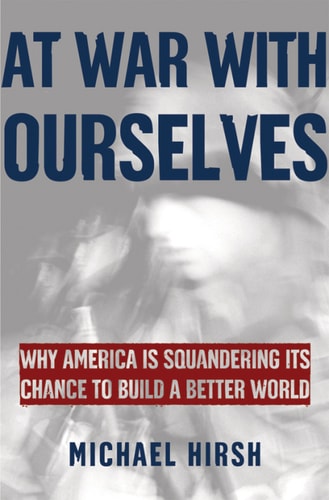
At War with Ourselves: Why America Is Squandering Its Chance to Build a Better World
0
0
As an Amazon Associate and affiliate partner, Menrva Books earns from qualifying purchases. Learn more
Author Description
As correspondent for Newsweek, Michael Hirsh has traveled to every continent, reporting on American foreign policy. Now he draws on his experience to offer an original explanation of America's role in the world and the problems facing the nation today and in the future. Using colorful vignettes and up-close reporting from his coverage of the first two post-Cold War presidents, Bill Clinton and George W. Bush, Hirsh argues that America has a new role never before played by any nation: it is the world's Uberpower, overseeing the global system from the air, land, sea and, increasingly, from space as well. And that means America has a unique opportunity do what no great power in history has ever done--to perpetuate indefinitely the global system it has built, to create an international community with American power at its center that is so secure it may never be challenged. Yet Americans are squandering this chance by failing to realize what is at stake. At the same time that America as a nation possesses powers it barely comprehends, Americans as individuals have vulnerabilities they never before imagined. They desperately need the international community on their side. In an era when democracy and free markets have become the prevailing ideology, Hirsh argues, one of America's biggest problems will be "ideological blowback"--facing up to the flaws and contradictions of its own ideals. Hence, for example, the biggest threat to political stability is not totalitarianism, but the tricky task of instituting democracy in the Arab world without giving Islamic fundamentalists the reigns of power. The only way for Washington to avoid accusations of hypocrisy is to allow the global institutions it has built, like the U.N., to do the hard work of promoting U.S. values.
Menrva's Summary
THE THESIS
Michael Hirsh investigates why the United States, as the world's sole 'Uberpower,' is failing to capitalize on its unique position to stabilize the global system. Drawing on his extensive experience as a Newsweek correspondent, Hirsh analyzes the post-Cold War presidencies of Bill Clinton and George W. Bush to illustrate the disconnect between American global dominance and domestic vulnerability. He argues that the nation must leverage international institutions to promote its values rather than acting unilaterally, which risks ideological blowback and instability.
THE SCOPE MAP
What You Will Find
- Analysis of the post-Cold War geopolitical landscape.
- Examination of the 'Uberpower' status of the United States.
- Discussion of the risks associated with promoting democracy in the Arab world.
- Evaluation of the role of international organizations like the U.N. in maintaining global order.
Scope Limits
- The text focuses primarily on the Clinton and Bush administrations and does not cover subsequent geopolitical developments.
- The analysis is centered on American foreign policy and does not provide a comprehensive history of global governance.
THE AUTHORITY PERSPECTIVE
Experts and readers frequently note that Hirsh provides a clear, journalistic perspective on the complexities of American hegemony. The book is often cited for its accessible prose and its focus on the practical challenges of maintaining a global order in an era of ideological conflict.
Page Count:
312
Publication Date:
2003-01-01
Publisher:
Oxford University Press
ISBN-10:
0190288272
ISBN-13:
9780190288273
History
American Studies
International Security
International relations
Globalization
National characteristics American
Foreign Policy
Community Tags
Similar Books