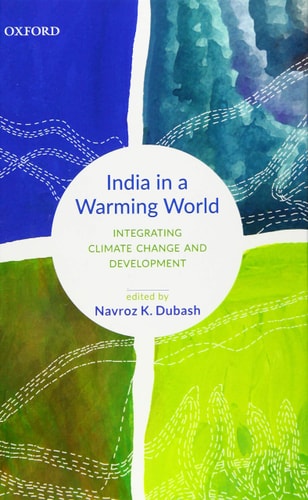
India in a Warming World: Integrating Climate Change and Development
0
0
As an Amazon Associate and affiliate partner, Menrva Books earns from qualifying purchases. Learn more
Author Description
Climate change is a 'wicked' problem--it is riven with scientific uncertainty, contending interests, and competing interpretations. For India, the challenges of addressing climate change are compounded by a sense of injustice - we did not cause the problem -- and immediate challenges of poverty and development. Yet, it is increasingly becoming clear that globally, climate change poses an existential challenge, and, in India, a pathway to development innocent of climate change is no longer possible.How is India facing up to the climate challenge? This volume brings together leading researchers and practitioners - negotiators, activists and policymakers--to lay out the emergent debate on climate change in India. The book covers climate impacts, negotiations, politics, policy, and the integration of climate concerns into sectoral debates, such as on energy and water. Each chapter provides an accessible entry point and a framework for understanding an aspect of India's engagement with climate change.A central theme of the book is that India has shifted from understanding the climate change problem as a diplomatic challenge to increasingly engaging with it as a developmental problem. To address this challenge requires integrating climate change and development, and doing so at multiple scales of governance - national, state, and local.
Menrva's Summary
THE THESIS
This volume investigates how India can effectively integrate the urgent requirements of national development with the existential necessity of climate change mitigation. Edited by Navroz K. Dubash, a prominent scholar in climate policy, the book synthesizes contributions from a diverse group of researchers, negotiators, and policymakers. It argues that India has transitioned from viewing climate change primarily as an external diplomatic burden to recognizing it as an internal developmental imperative that requires multi-scalar governance.
THE SCOPE MAP
What You Will Find
- Analysis of climate impacts across diverse Indian sectors including energy and water.
- Frameworks for integrating climate policy into national, state, and local governance structures.
- Examination of the historical and political tensions between global climate responsibility and domestic poverty alleviation.
- Case studies and expert perspectives on the evolution of India's climate negotiation strategies.
THE AUTHORITY PERSPECTIVE
Experts identify this volume as a foundational text for understanding the intersection of environmental policy and economic development in the Global South. Readers frequently note the clarity of the prose, which makes complex policy debates accessible to both students and practitioners in the field.
Page Count:
504
Publication Date:
2020-01-01
Publisher:
Oxford University Press
ISBN-10:
0199498733
ISBN-13:
9780199498734
India
Climate Change
Public Policy
Economic History
Community Tags
Similar Books