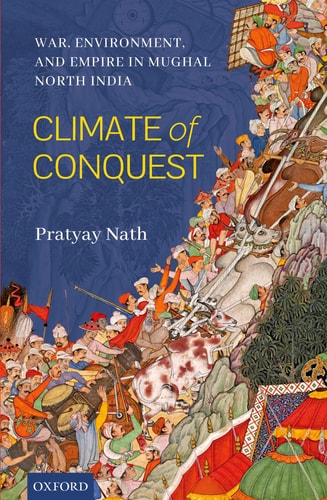
Climate of Conquest: War, Environment, and Empire in Mughal North India
0
0
As an Amazon Associate and affiliate partner, Menrva Books earns from qualifying purchases. Learn more
Author Description
What can war tell us about empire? Climate of Conquest is built around this question. Here the author eschews the conventional way of writing about warfare primarily in terms of battles and technologies. Instead, he unravels the deep connections that Mughal war-making shared with the broader dynamics of society, culture, and politics. In the process, he offers a new analysis of the Mughal empire from the vantage point of war.Climate of Conquest closely studies the dynamics of the military campaigns that helped the Mughals conquer North India and project their power beyond it. The author argues that these campaigns unfolded in constant negotiation with the diverse natural environment of South Asia. The empire sought to discipline the environment and harness its resources to satisfy its own military needs. At the same time, environmental factors like climate, terrain, and ecology profoundly influenced Mughal military tactics, strategy, and deployment of technology. The book also explores the world of non-elite labour that spearheaded Mughal military logistics, the process of formation of imperial frontiers, and the empire's legitimisation of war and conquest. What emerges is a fresh interpretation of Mughal empire-building as a highly adaptive, flexible, and accommodative process.
Menrva's Summary
THE THESIS
This book investigates how the Mughal Empire utilized military campaigns as a lens to understand the complex interplay between imperial expansion, environmental adaptation, and political consolidation in North India. Dr. Pratyay Nath, a specialist in early modern South Asian history, challenges traditional military historiography by shifting the focus from mere battlefield tactics to the socio-political and ecological dimensions of warfare. By analyzing primary records and administrative documents, the author argues that the Mughal state was not a static entity but a highly adaptive power that constantly negotiated with the diverse natural landscape to sustain its military logistics and territorial reach.
THE SCOPE MAP
What You Will Find
- Analysis of Mughal military campaigns in North India and their expansion beyond regional frontiers.
- Examination of the relationship between environmental factors such as climate, terrain, and ecology and military strategy.
- Investigation into the role of non-elite labor forces in maintaining imperial military logistics.
- Exploration of the ideological and political processes used by the empire to legitimize conquest and define its borders.
THE AUTHORITY PERSPECTIVE
Scholars and historians recognize this work as a significant contribution to the study of early modern empires, particularly for its integration of environmental history with military analysis. Readers frequently note the academic rigor of the research and the author's ability to synthesize complex administrative data into a coherent narrative of imperial adaptation.
Page Count:
368
Publication Date:
2019-11-19
Publisher:
Oxford University Press
ISBN-10:
0199495556
ISBN-13:
9780199495559
History
Asian History
Military History
Writing Guides
Reference
Writing
India
Kindle eBooks
Theater
Environmental History
Categories
Kindle Store
Community Tags
Similar Books