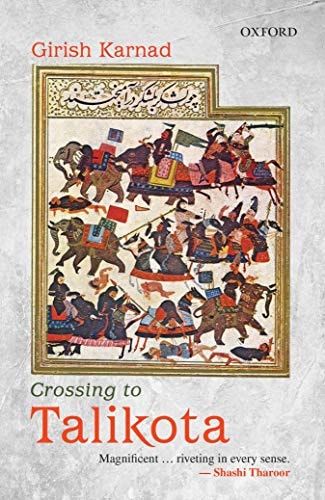
Crossing to Talikota
0
0
As an Amazon Associate and affiliate partner, Menrva Books earns from qualifying purchases. Learn more
Author Description
The battle of Talikota in 1565 radically altered the contours of the political map of India within a space of a few hours. The Vijayanagara empire, which straddled the whole of South India, collapsed in the face of four minor Sultanates with little resistance, while its capital, one of the most prosperous cities in the world, was plundered, decimated and lay uninhabited for the next few centuries, known to the world outside only as 'the ruins of Hampi'. At the centre of this cataclysm was 'Aliya' Ramaraya, ambitious, ruthless, brilliant strategist, a son-in-law of the emperor but unacceptable within the royal lineage, generalissimo who ruled the empire without being allowed to step on its throne. The play explores in detail the complex of gender, caste, clan and religious loyalties that brought the various forces together to explode in an unforeseen catastrophe.
Menrva's Summary
THE PULSE
The collapse of the Vijayanagara empire at the Battle of Talikota serves as the catalyst for this dramatic exploration of power and betrayal. Through the perspective of 'Aliya' Ramaraya, the play examines the internal fractures of a once-prosperous state facing external military pressure. The narrative navigates the rigid social hierarchies of caste and clan that dictate the actions of the ruling elite. As the empire teeters on the brink of destruction, the protagonist must reconcile his personal ambition with the shifting loyalties of his subordinates and rivals.
INSIDE THE PAGES
- Focuses on the historical Battle of Talikota in 1565.
- Explores the political dynamics of the Vijayanagara empire.
- Examines the intersection of caste, gender, and religious identity in medieval India.
- Features a central character study of the strategist 'Aliya' Ramaraya.
- Utilizes the dramatic form to reconstruct the fall of Hampi.
- Analyzes the tension between royal lineage and de facto political power.
- Investigates the geopolitical consequences of the sultanates' alliance.
- Highlights the fragility of urban prosperity in the face of sudden military conflict.
THE COLLECTIVE ECHO
Readers and critics frequently highlight the play's ability to transform complex historical events into a focused, character-driven narrative. Discussion often centers on the nuanced portrayal of Ramaraya, whose ambition is presented as both a source of strength and a fatal flaw. The work is praised for its meticulous attention to the social and political undercurrents that defined the period. Observers note that the play effectively balances the grand scale of imperial collapse with the intimate, often claustrophobic, nature of court intrigue. This text remains a significant contribution to historical drama, offering a lens through which to view the structural vulnerabilities of power.
Page Count:
144
Publication Date:
2019-10-01
Publisher:
Oxford University Press
ISBN-10:
0199496153
ISBN-13:
9780199496150
Politics
Drama
Kindle eBooks
Reference
Indian History
Plays
Categories
British & Irish
Kindle Store
Writing
Dramas & Plays
Writing Guides
Political
Theater
Kindle Short Reads
Human Resources
Womens Studies
Historical
Community Tags
Similar Books