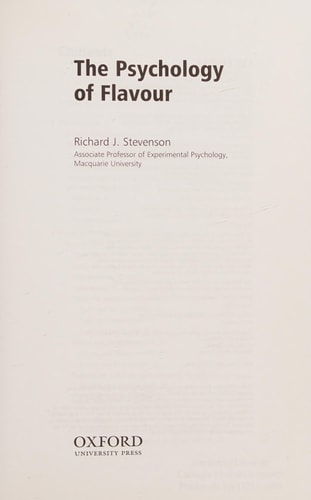
The Psychology of Flavour
0
0
As an Amazon Associate and affiliate partner, Menrva Books earns from qualifying purchases. Learn more
Author Description
Flavour is arguably the most fascinating aspect of eating and drinking. It utilises a complex variety of senses and processes, that incredibly work together to generate a unified, and hopefully pleasurable, experience. The processes involved are not just those involved in tasting at the time of eating, but also memory and learning processes - we obviously shun those foods of which we have a negative memory, and favour those we enjoy. Our understanding of the science of flavour has improved in recent years, benefiting psychology, cuisine, food science, oenology, and dietetics.This book describes what is known about the psychology and biology of flavour. Written by an authority in the field, it is divided into two parts. The first explores what we know about the flavour system; including the role of learning and memory in flavour perception and hedonics; the way in which all the senses that contribute to flavour interact, and our ability to perceive flavour as a whole and as a series of parts. The later chapters examine a range of theoretical issues concerning the flavour system. This includes a look at multisensory processing, and the way in which the mind and brain bind information from discrete sensory systems. It also examines the broader implications of studying flavour for societal problems such as obesity. Written in an accessible style, that assumes little prior knowledge of the field, the book will be valuable for psychologists interested in perception, neuroscientists, food scientists, and dieticians.
Menrva's Summary
THE THESIS
This book investigates the complex biological and psychological mechanisms that allow humans to perceive, learn, and remember flavour. Richard Stevenson, an expert in the field, synthesizes current research from psychology, neuroscience, and food science to explain how sensory input and cognitive processes integrate to create the experience of eating. The text provides a comprehensive framework for understanding how memory and learning influence our food preferences and how the brain binds multisensory information into a unified perception.
THE SCOPE MAP
What You Will Find
- Analysis of the role of memory and learning in flavour perception and hedonics.
- Examination of multisensory processing and how the brain integrates discrete sensory inputs.
- Discussion of the broader societal implications of flavour research, including its relevance to obesity.
- An overview of the biological and psychological systems that constitute the human flavour system.
THE AUTHORITY PERSPECTIVE
Experts and academics recognize this work as a clear, accessible introduction to the intersection of sensory science and psychology. Readers frequently note that the text successfully bridges the gap between complex neuroscientific concepts and practical applications in dietetics and food science.
Page Count:
312
Publication Date:
2009-08-03
Publisher:
Oxford University Press
ISBN-10:
0199539359
ISBN-13:
9780199539352
Psychology
Flavor
Neuroscience
Food Science
Biology
Dietetics
Community Tags
Similar Books