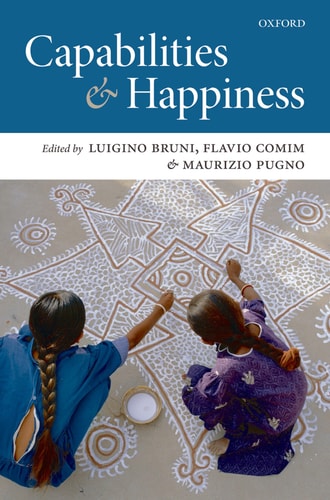
Capabilities and Happiness
0
0
As an Amazon Associate and affiliate partner, Menrva Books earns from qualifying purchases. Learn more
Author Description
Few would dispute that the well-being of individuals is one of the most desirable aims of human actions. However, approaches on how to define, measure, evaluate, and promote well-being differ widely. The conventional economic approach takes income (or the power to acquire market goods) as the most important indicator for well-being, and the utility function as the formal device for positive and normative analysis. However, this approach to well-being has been questioned for being seriously limited and other approaches have arisen.The capability approach to well-being, which has been developed during the last two decades by Amartya Sen and Martha Nussbaum, and the Happiness Approach to well-being, championed by Richard Easterlin, both provide an alternative. Both approaches come from different traditions and have developed independently, but nevertheless aim to overcome the rigid boundaries of the conventional economic approach to well-being. Given these common aims, it is surprising that little comparative work has been undertaken across these approaches. This book aims to correct this by providing the reader with contributions from leading names associated with both approaches, as well as contributions which evaluate the approaches and contrast one with the other.
Menrva's Summary
THE THESIS
This book investigates the theoretical and practical intersections between the capability approach and the happiness approach to define and measure human well-being. The authors, including Flavio Comim, Luigino Bruni, and Maurizio Pugno, curate a collection of essays that challenge the traditional economic reliance on income as the primary metric for human welfare. By contrasting the frameworks established by scholars like Amartya Sen, Martha Nussbaum, and Richard Easterlin, the text provides a rigorous evaluation of how these alternative models can better inform normative analysis and public policy.
THE SCOPE MAP
What You Will Find
- Comparative analysis of the capability approach versus the happiness approach to well-being.
- Theoretical critiques of conventional income-based economic indicators.
- Scholarly contributions from leading experts in welfare economics and philosophy.
- Methodological frameworks for evaluating individual and societal happiness.
THE AUTHORITY PERSPECTIVE
Experts recognize this volume as a significant contribution to the discourse on welfare economics, particularly for its attempt to bridge the gap between two distinct intellectual traditions. Readers frequently note the academic density of the prose, making it a valuable resource for researchers and graduate students in economics and political philosophy.
Page Count:
416
Publication Date:
2009-01-15
Publisher:
Oxford University Press
ISBN-10:
0199532141
ISBN-13:
9780199532148
Economics
Philosophy
Public Policy
Economics
Social Science
Macroeconomic Theory
Happiness
well being
Community Tags
Similar Books