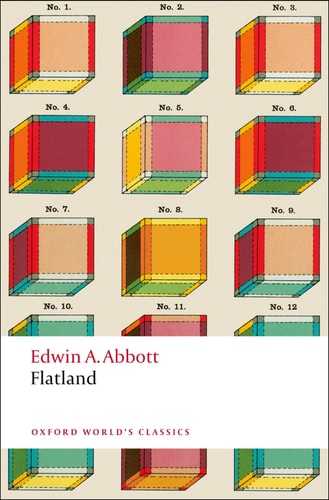
Flatland: A Romance of Many Dimensions
0
0
As an Amazon Associate and affiliate partner, Menrva Books earns from qualifying purchases. Learn more
Author Description
How would a creature limited to two dimensions be able to grasp the possibility of a third? Edwin A. Abbott's droll and delightful "romance of many dimensions" explores this conundrum in the experiences of his protagonist, A Square, whose linear world is invaded by an emissary Sphere bringing the gospel of the third dimension. Part geometry lesson, part social satire, this classic work of science fiction brilliantly succeeds in enlarging all readers' imaginations beyond the limits of their "respective dimensional prejudices."This new edition begins with an introduction by Rosemary Jann that illuminates the social and intellectual context that produced the work and explains its relationship to the theological issues central to Abbott's career. It also provides the most extensive discussion to date of the class and gender issues raised by the text and of the debates over the limits of scientific and mathematical knowledge in which it participated.Flatland^'s unique combination of astute social, philosophical, and mathematical observations with wit and humor can be read at many different levels, and will prove especially enjoyable to readers of Victorian literature and philosophy.About the Series: For over 100 years Oxford World's Classics has made available the broadest spectrum of literature from around the globe. Each affordable volume reflects Oxford's commitment to scholarship, providing the most accurate text plus a wealth of other valuable features, including expert introductions by leading authorities, voluminous notes to clarify the text, up-to-date bibliographies for further study, and much more.
Menrva's Summary
THE PULSE
A two-dimensional inhabitant of Flatland encounters a visitor from the third dimension, forcing him to confront the limitations of his own reality. The protagonist, a geometric figure known as A Square, lives in a rigid, hierarchical society governed by strict laws of shape and social standing. When he is visited by a Sphere, he is physically and intellectually challenged to perceive a world beyond his own, leading to his imprisonment for heresy. The narrative is presented as an autobiographical account, utilizing a first-person perspective to document the protagonist's transition from a narrow-minded citizen to an enlightened exile.
INSIDE THE PAGES
- Allegorical exploration of social class and gender hierarchies in Victorian society.
- Mathematical conceptualization of higher dimensions through geometric analogies.
- Satirical critique of rigid societal structures and intellectual dogmatism.
- First-person narrative voice providing an intimate view of the protagonist's cognitive shift.
- World-building based on Euclidean geometry and dimensional constraints.
- Philosophical inquiry into the nature of perception and objective truth.
- Use of irony to highlight the absurdity of dimensional prejudice.
- Didactic structure that blends narrative fiction with theoretical exposition.
THE COLLECTIVE ECHO
Readers frequently highlight the cleverness with which Abbott uses simple geometric shapes to mirror complex human social behaviors. Discussion often centers on the book's dual nature as both a mathematical curiosity and a biting critique of Victorian class stratification. Critics often note that the pacing is deliberate, prioritizing philosophical inquiry and world-building over traditional plot-driven action. The work remains a staple for those interested in the intersection of speculative fiction and early scientific philosophy, as it effectively challenges the reader to reconsider the boundaries of their own perspective.
Page Count:
176
Publication Date:
2008-08-15
Publisher:
Oxford University Press
ISBN-10:
019953750X
ISBN-13:
9780199537501
Classics
Philosophy
Science Fiction
Satire
Victorian
Mathematics
Fourth Dimension
Community Tags
Other Editions(6)



Similar Books






Reader Comments
Share Your Thoughts
No comments yet. Be the first to share your thoughts!