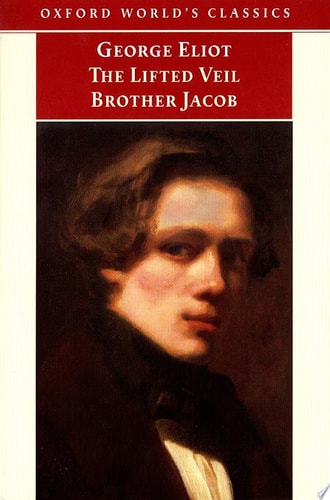
The Lifted Veil / Brother Jacob
0
0
As an Amazon Associate and affiliate partner, Menrva Books earns from qualifying purchases. Learn more
Author Description
First published in Blackwood's Magazine in 1859, "The Lifted Veil" is now one of George Eliot's most widely read and critically discussed short stories. A dark fantasy drawing on contemporary scientific interest in the physiology of the brain, mesmerism, phrenology, and experiments in revification, it is Eliot's anatomy of her own moral philosophy. Narrated by an egocentric, morbid young clairvoyant man, the story also explores fiction's ability to offer insight into the self, as well as being a remarkable portrait of an artist whose visionary powers merely blight his life.Published as a companion piece to "The Lifted Veil," "Brother Jacob" is by contrast Eliot's literary homage to Thackeray, a satirical modern fable that draws telling parallels between eating and reading. With an illuminating introduction by Helen Small, this Oxford World's Classics edition makes newly available two fascinating short stories which fully deserve to be read alongside Eliot's novels.
Menrva's Summary
THE PULSE
In The Lifted Veil, a man cursed with the ability to foresee the future and read the thoughts of others finds his life unraveling as he becomes trapped in a marriage he knows will lead to his destruction. The protagonist, Latimer, struggles against the isolation of his clairvoyance, a condition that renders him detached from the human experience and hyper-aware of the deceit surrounding him. The narrative is presented as a first-person confession, detailing his descent into morbidity and his eventual confrontation with the limits of scientific and supernatural knowledge. In Brother Jacob, the narrative shifts to a satirical fable concerning a man whose obsession with confectionery leads to his social and moral downfall, contrasting sharply with the somber tone of the primary story.
INSIDE THE PAGES
- First-person confessional narrative style
- Exploration of Victorian scientific interests like mesmerism and phrenology
- Gothic atmosphere and psychological dread
- Satirical social commentary on greed and vanity
- Examination of the burden of foresight
- Homage to Thackeray-style prose in Brother Jacob
- Philosophical inquiry into moral responsibility
- Focus on the isolation of the artist figure
THE COLLECTIVE ECHO
Readers and critics frequently note that these stories provide a unique window into George Eliot's intellectual preoccupations outside of her longer novels. Discussion often centers on the stark contrast between the haunting, psychological intensity of The Lifted Veil and the lighter, more biting satire found in Brother Jacob. Scholars highlight the effectiveness of Eliot's prose in capturing the anxieties of the Victorian era regarding science and human nature. Many readers appreciate the inclusion of these works as they demonstrate the author's versatility in tone and thematic focus. The collection is widely regarded as a significant addition for those interested in the evolution of nineteenth-century psychological fiction.
Page Count:
160
Publication Date:
1999-11-11
Publisher:
Oxford University Press
ISBN-10:
0192832956
ISBN-13:
9780192832955
Fantasy
Satire
Gothic
Victorian
Short Stories
classic
Fiction psychological
Community Tags
Similar Books