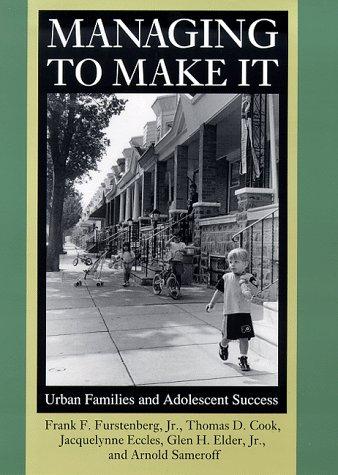
Managing to Make It
0
0
As an Amazon Associate and affiliate partner, Menrva Books earns from qualifying purchases. Learn more
Author Description
One of the myths about families in inner-city neighborhoods is that they are characterized by poor parenting. The distinguished sociologist Frank Furstenberg and his colleagues explode this and other misconceptions about success, parenting, and socioeconomic advantage in Managing to Make It. Based on nearly 500 interviews and qualitative case studies of families in inner-city Philadelphia, Managing to Make It reveals how parents and their teenage children managed different levels of resources and dangers in low-income neighborhoods and how families and communities contributed to the development of children. Challenging misconceptions about life in the inner-city, Managing to Make It shows that poor parenting is not necessarily more common in disadvantaged neighborhoods and explains why neighborhood advantaged is not invariably linked to success. At the same time the study offers a wealth of information about programs, services, and policy decisions that will be indispensable to policy makers, sociologists, educators, and anyone concerned with the fate of the urban poor.
Menrva's Summary
THE THESIS
This book challenges pervasive myths about parenting and success in disadvantaged urban neighborhoods. Based on extensive research including nearly 500 interviews and qualitative case studies in inner-city Philadelphia, Frank F. Furstenberg and his colleagues investigate how parents and teenagers navigate limited resources and significant dangers. The study reveals the complex interplay between families, communities, and child development, arguing against the notion that poor parenting is inherently more common in low-income areas and questioning the direct link between neighborhood advantage and individual success.
THE SCOPE MAP
- Analysis of parenting strategies in low-income urban neighborhoods.
- Exploration of how families and communities foster child development.
- Debunking misconceptions about socioeconomic advantage and success.
- Examination of the relationship between neighborhood resources and outcomes.
- Case studies of families in inner-city Philadelphia.
- Information on programs, services, and policy decisions relevant to urban poverty.
THE AUTHORITY PERSPECTIVE
The book is presented as a significant sociological study that directly confronts and debunks common misconceptions about families in inner-city neighborhoods. It aims to provide a more nuanced understanding of parenting, success, and the impact of socioeconomic disadvantage. The research is positioned as essential reading for policymakers, educators, and anyone concerned with the welfare of urban populations, offering data-driven insights to inform policy and practice.
Page Count:
305
Publication Date:
1999-01-01
ISBN-10:
0226273911
Non-Fiction
Science
History
Psychology
Health
Poverty
Sociology
Family Studies
Urban Studies
Parenting
Community Tags
Similar Books