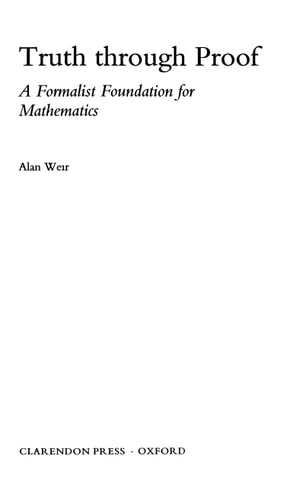
Truth Through Proof: A Formalist Foundation for Mathematics
0
0
As an Amazon Associate and affiliate partner, Menrva Books earns from qualifying purchases. Learn more
Author Description
Truth Through Proof defends an anti-platonist philosophy of mathematics derived from game formalism. Classic formalists claimed implausibly that mathematical utterances are truth-valueless moves in a game. Alan Weir aims to develop a more satisfactory successor to game formalism utilising a widely accepted, broadly neo-Fregean framework, in which the proposition expressed by an utterance is a function of both sense and background circumstance. This framework allows for sentences whose truth-conditions are not representational, which are made true or false by conditions residing in the circumstances of utterances but not transparently in the sense.Applications to projectivism and fiction pave the way for the claim that mathematical utterances are made true or false by the existence of concrete proofs or refutations, though these truth-making conditions form no part of their sense or informational content.The position is compared with rivals, an account of the applicability of mathematics developed, and a new account of the nature of idealisation proffered in which it is argued that the finitistic limitations Godel placed on proofs are without rational justification. Finally a non-classical logical system is provided in which excluded middle fails, yet enough logical power remains to recapture the results of standard mathematics.
Menrva's Summary
THE THESIS
This book investigates whether an anti-platonist philosophy of mathematics can be sustained through a refined version of game formalism. Alan Weir, a philosopher specializing in logic and the foundations of mathematics, utilizes a neo-Fregean framework to argue that mathematical statements derive their truth values from concrete proofs rather than representational content. By separating the sense of an utterance from its truth-making conditions, the author attempts to resolve long-standing tensions between formalist theory and the practical application of mathematical systems.
THE SCOPE MAP
What You Will Find
- A neo-Fregean framework for analyzing mathematical propositions and truth-conditions.
- A critical evaluation of traditional game formalism and its limitations.
- A proposed non-classical logical system where the law of excluded middle is modified.
- An analysis of mathematical idealization and the finitistic constraints attributed to Godel.
THE AUTHORITY PERSPECTIVE
Experts in the philosophy of mathematics recognize this text as a rigorous contribution to the debate between platonist and anti-platonist schools of thought. Readers frequently note the technical density of the prose, which requires a strong background in formal logic to fully grasp the proposed system.
Page Count:
256
Publication Date:
2010-12-09
Publisher:
Oxford University Press
ISBN-10:
0199541493
ISBN-13:
9780199541492
Non-Fiction
Philosophy
Logic
Epistemology
Mathematics
Community Tags
Similar Books