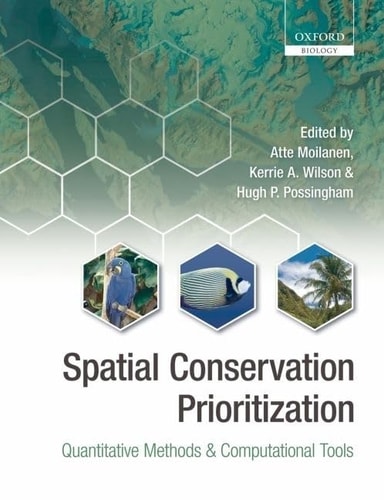
Spatial Conservation Prioritization: Quantitative Methods and Computational Tools
0
0
As an Amazon Associate and affiliate partner, Menrva Books earns from qualifying purchases. Learn more
Author Description
Habitat loss and deterioration, climate change, and economic pressures for resource extraction have all led to a global loss of biodiversity. The limited resources available for conservation need to be used both effectively and efficiently in order to minimise further losses. Spatial conservation prioritization addresses the question of how we should allocate conservation effort and funds in space and time. While the benefits of quantitative conservation prioritization methods have been widely promoted, adoption of these methods in "real-world" planning and implementation is still in its infancy, partly due to the difficulty of identifying which methods and tools (if any) are suited to specific planning problems.Spatial Conservation Prioritization brings together a team of leading scientists to introduce the conceptual and methodological aspects of how to undertake spatial conservation planning in a quantitative manner. It provides the reader with information on when, why, and how to use which statistical and computational methods for conservation prioritization. Important topics underlying spatial prioritization including metapopulation modelling, population viability analysis modelling, species distribution modelling, and uncertainty analysis are discussed, as well as operational definitions and methods. The book includes chapters on the most widely used and latest software, and concludes with an insight into the future of the field.
Menrva's Summary
THE THESIS
This book investigates how quantitative methods and computational tools can be systematically applied to allocate limited conservation resources effectively across space and time. The authors, leading experts in the field of conservation biology, synthesize complex ecological modeling techniques to bridge the gap between theoretical research and practical, real-world environmental planning. By providing a structured framework for decision-making, the text addresses the urgent need to mitigate biodiversity loss caused by habitat destruction and climate change.
THE SCOPE MAP
What You Will Find
- Methodological frameworks for spatial conservation planning and resource allocation.
- Technical analysis of metapopulation modeling and population viability analysis.
- Integration of species distribution modeling and uncertainty analysis in planning.
- Comparative reviews of widely used software tools for conservation prioritization.
THE AUTHORITY PERSPECTIVE
Experts recognize this work as a foundational technical reference for practitioners and researchers involved in biodiversity management. Readers frequently note the academic density of the prose, which serves as a comprehensive manual for applying quantitative rigor to conservation strategy.
Page Count:
320
Publication Date:
2009-08-03
Publisher:
Oxford University Press
ISBN-10:
0199547769
ISBN-13:
9780199547760
Science
Mathematics
Natural Resources
Statistics
Conservation
Ecology
Community Tags
Similar Books