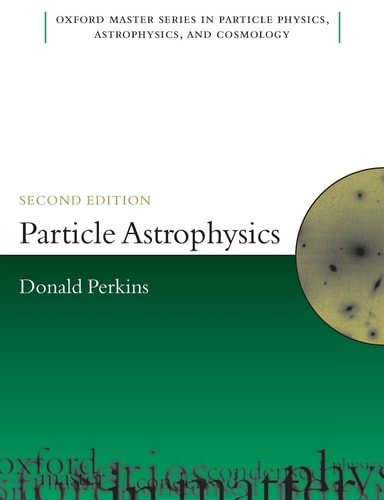
Particle Astrophysics
0
0
As an Amazon Associate and affiliate partner, Menrva Books earns from qualifying purchases. Learn more
Author Description
The last years have seen a symbiosis of the fields of elementary particle physics and the astrophysics of the early universe. This text presents the background of the subjects and the latest developments at a level suitable for final year undergraduates and beginning graduate students. The first chapters cover the properties and interactions of elementary particles followed by discussion of the early universe, including inflation, dark matter and dark energy, and the growth of the galactic structure. The final chapters discuss cosmic rays and particle physics in the stars. The close relation between particle interactions and large scale development of the cosmos is a constant theme in the text, with emphasis on the interplay between experiment and theory.This book is an enlarged and updated version of the first edition published five years ago. In a rapidly evolving field, emphasis has of course been placed on the most recent developments. However, the opportunity has also been taken to re-arrange the material and present it in more detail and at somewhat greater length.
Menrva's Summary
THE THESIS
This text investigates the intersection of elementary particle physics and cosmology to explain the evolution of the early universe. D. H. Perkins, a distinguished physicist, utilizes his extensive background in high-energy physics to synthesize complex data regarding particle interactions and their influence on galactic structures. The book provides a rigorous framework for understanding how subatomic phenomena dictate the large-scale development of the cosmos, bridging the gap between theoretical models and experimental observations.
THE SCOPE MAP
What You Will Find
- Comprehensive analysis of elementary particle properties and their fundamental interactions.
- Theoretical frameworks for inflation, dark matter, and dark energy.
- Detailed examination of cosmic rays and the role of particle physics in stellar evolution.
- Methodological focus on the interplay between experimental data and theoretical cosmological models.
THE AUTHORITY PERSPECTIVE
Experts and educators recognize this work as a foundational text for advanced physics students due to its clear integration of particle physics and astrophysics. Readers frequently note the academic density of the prose, which requires a solid background in undergraduate physics to fully grasp the presented concepts.
Page Count:
360
Publication Date:
2009-02-04
Publisher:
Oxford University Press
ISBN-10:
0199545464
ISBN-13:
9780199545469
Science
Physics
Astrophysics
Nuclear Physics
textbook
Community Tags
Other Editions(3)
Similar Books