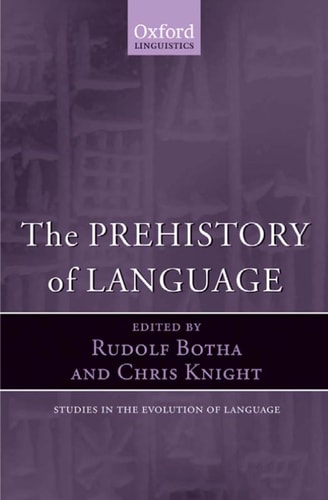
The Prehistory of Language
0
0
As an Amazon Associate and affiliate partner, Menrva Books earns from qualifying purchases. Learn more
Author Description
'When, why, and how did language evolve?' 'Why do only humans have language?' This book looks at these and other questions about the origins and evolution of language. It does so via a rich diversity of perspectives, including social, cultural, archaeological, palaeoanthropological, musicological, anatomical, neurobiological, primatological, and linguistic. Among the subjects it considers are: how far sociality is a prerequisite for language; the evolutionary links between language and music; the relation between natural selection and niche construction; the origins of the lexicon; the role of social play in language development; the use of signs by great apes; the evolution of syntax; the evolutionary biology of language; the insights offered by Chomsky's biolinguistic approach to mind and language; the emergence of recursive language; the selectional advantages of the human vocal tract; and why women speak better than men.The authors, drawn from all over the world, are prominent linguists, psychologists, cognitive scientists, archaeologists, primatologists, social anthropologists, and specialists in artificial intelligence. As well as explaining what is understood about the evolution of language, they look squarely at the formidable obstacles to knowing more - the absence of direct evidence, for example; the problems of using indirect evidence; the lack of a common conception of language; confusion about the operation of natural selection and other processes of change; the scope for misunderstanding in a multi-disciplinary field, and many more. Despite these difficulties, the authors in their stylish and readable contributions to this book are able to show just how much has been achieved in this most fruitful and fascinating area of research in the social, natural, and cognitive sciences.
Menrva's Summary
THE THESIS
This volume investigates the complex evolutionary origins of human language by synthesizing diverse scientific perspectives to address why and how language emerged exclusively in the human species. The editors, Chris Knight and Rudolf Botha, curate a collection of contributions from international experts in fields ranging from primatology and archaeology to artificial intelligence and neurobiology. The text establishes a multidisciplinary framework to evaluate the biological, social, and cultural pressures that facilitated the development of syntax, lexicon, and recursive communication.
THE SCOPE MAP
What You Will Find
- Analysis of the evolutionary links between sociality, music, and linguistic development.
- Examination of the role of natural selection and niche construction in human cognitive evolution.
- Evaluation of indirect evidence from primatology, anatomy, and palaeoanthropology to bridge the gap in the fossil record.
- Discussion of the biolinguistic approach to the mind and the functional advantages of the human vocal tract.
THE AUTHORITY PERSPECTIVE
Experts recognize this collection as a comprehensive survey of the current state of research into language evolution, noting its ability to navigate the inherent difficulties of a multidisciplinary field. Readers frequently highlight the academic rigor of the contributions while appreciating the clarity with which the authors address the significant obstacles to understanding human linguistic origins.
Page Count:
352
Publication Date:
2009-06-22
Publisher:
Oxford University Press
ISBN-10:
0199545871
ISBN-13:
9780199545872
Science
Archaeology
Evolutionary Biology
Anthropology
Linguistics
Anthropological linguistics
Historical linguistics
Community Tags
Other Editions(2)
Similar Books









Reader Comments
Share Your Thoughts
No comments yet. Be the first to share your thoughts!