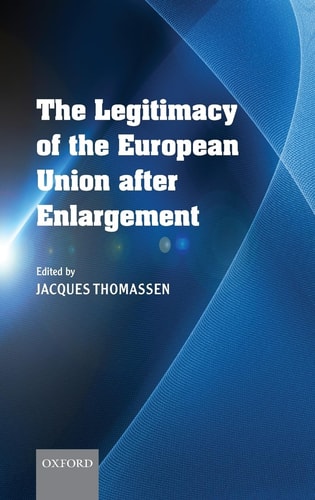
The Legitimacy of the European Union After Enlargement
0
0
As an Amazon Associate and affiliate partner, Menrva Books earns from qualifying purchases. Learn more
Author Description
In 2004 the European Union was enlarged with ten new member states, eight of them previously communist states in Central and Eastern Europe. This enlargement was without precedent in the history of the Union and its predecessors. It is still to be seen how well the institutions as well as the citizens of the Union are able to cope with the consequences of this operation.The authors of this volume evaluate the effect of that enlargement on its legitimacy. They do so by assessing the effects of enlargement on the functioning of the process of political representation in the European Union and on the feelings of the European people towards the Union. This study is mainly based on data from the European Election Study 2004. This study made it for the first time possible to compare the attitudes and behavior of citizens in the enlargement countries, in particular in Central and Eastern Europe, with their counterparts in the older member states.Some of the findings of this study are counterintuitive. In many respects the effects of enlargements are much smaller than often argued. The party systems of the new member states and the attitudes and behavior of the voters of individual parties are very compatible with their counterparts in the older member states, making further European integration relatively easy. The same can be said about members of the European Parliament. On the other hand the mutual trust of the people in the older and new member states is extremely low and undermines the legitimacy of the enlarged Union.
Menrva's Summary
THE THESIS
This volume investigates how the 2004 enlargement of the European Union impacted the institutional and democratic legitimacy of the organization. Jacques Thomassen and his contributors utilize data from the 2004 European Election Study to analyze the political integration of ten new member states, primarily from Central and Eastern Europe. The authors examine the functioning of political representation and citizen attitudes to determine if the expansion hindered or facilitated the Union's cohesion. By comparing voter behavior and party systems across old and new member states, the research provides a empirical assessment of the Union's post-enlargement stability.
THE SCOPE MAP
What You Will Find
- Comparative analysis of political representation processes in pre
- and post-2004 EU member states.
- Quantitative data derived from the 2004 European Election Study regarding voter attitudes and party alignment.
- Evaluation of institutional compatibility between established Western European democracies and former communist states.
- Assessment of mutual trust levels among citizens of diverse member nations and its impact on political legitimacy.
THE AUTHORITY PERSPECTIVE
Experts identify this work as a critical empirical study for understanding the immediate political aftermath of the 2004 EU expansion. Scholars frequently cite the text for its nuanced findings regarding the surprising compatibility of party systems despite low levels of interpersonal trust between member populations.
Page Count:
286
Publication Date:
2009-08-03
Publisher:
Oxford University Press
ISBN-10:
0199548994
ISBN-13:
9780199548996
History
International relations
Sociology
European Union
Community Tags
Other Editions(2)

Similar Books