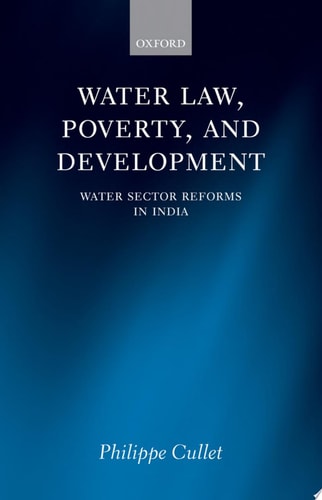
Water Law, Poverty, and Development
0
0
As an Amazon Associate and affiliate partner, Menrva Books earns from qualifying purchases. Learn more
Author Description
This monograph comprehensively examines water law regulations and reform in the present decade, going beyond a simple analysis of existing water law and regulations to encompass environmental, social, economic, and human rights aspects of water as a natural resource.Using the specific case of India and on the related international law and policy framework that directly influences water regulatory developments in India, this book offers what will be the first and only analysis of water law reforms taking place at the national level in many developing countries in their domestic and international context. On the one hand, international freshwater law remains under-developed and existing legal instruments such as the 1997 UN Convention only address a limited set of relevant issues. Yet, the international law and policy framework concerning freshwater is increasingly important in shaping up law reforms taking place at the national level, in particular in developing countries. Indeed, non-binding resolutions such as the Dublin Statement on Water and Sustainable Development (1992) have had an immense influence on water law reforms in most developing countries.This book seeks to conceive of and analyze freshwater regulation in a broader context, and go beyond a literature that either lauds or criticizes ongoing water sector reforms to provide an analytical basis for the reforms which all countries will have to adopt in the near or medium-term future.
Menrva's Summary
THE THESIS
This monograph investigates how contemporary water law reforms in developing nations intersect with human rights, environmental sustainability, and economic development. Philippe Cullet, an expert in international environmental law, utilizes the case study of India to analyze the tension between domestic regulatory shifts and the influence of international policy frameworks. The book argues that current water management strategies often fail to address the needs of the impoverished, proposing a more holistic legal approach that integrates social equity with resource management.
THE SCOPE MAP
What You Will Find
- Analysis of the 1997 UN Convention on the Law of the Non-Navigational Uses of International Watercourses.
- Examination of the impact of the Dublin Statement on Water and Sustainable Development on national legislation.
- Comparative study of Indian water regulatory reforms within a global context.
- Integration of human rights, economic, and environmental perspectives into water resource governance.
THE AUTHORITY PERSPECTIVE
Experts recognize this work as a foundational text for understanding the intersection of water rights and development policy in the Global South. Readers frequently note the academic density of the prose, which provides a rigorous analytical framework for legal scholars and policy practitioners alike.
Page Count:
250
Publication Date:
2009-09-21
Publisher:
Oxford University Press
ISBN-10:
0199546231
ISBN-13:
9780199546237
International Law
Public Policy
Water Resources
Law And Legislation
Law
Community Tags
Similar Books