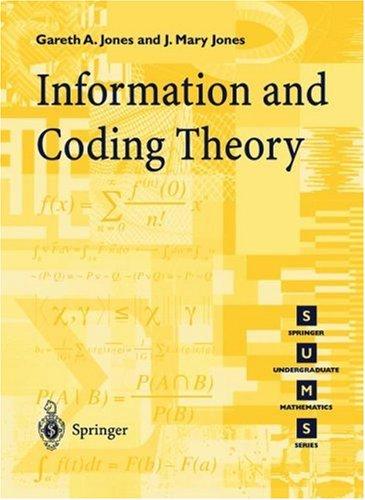
Information and Coding Theory
0
0
As an Amazon Associate and affiliate partner, Menrva Books earns from qualifying purchases. Learn more
Author Description
This book provides an elementary introduction to Information Theory and Coding Theory - two related aspects of the problem of how to transmit information efficiently and accurately. The first part of the book focuses on Information Theory, covering uniquely decodable and instantaneous codes, Huffman coding, entropy, information channels, and Shannon's Fundamental Theorem. In the second part, on Coding Theory, linear algebra is used to construct examples of such codes, such as the Hamming, Hadamard, Golay and Reed-Muller codes. The book emphasises carefully explained proofs and worked examples; exercises (with solutions) are integrated into the text as part of the learning process. Only some basic probability theory and linear algebra, together with a little calculus (as covered in most first-year university syllabuses), is assumed, making it suitable for second- and third-year undergraduates in mathematics, electronics and computer science.
Menrva's Summary
THE THESIS
This book introduces the fundamental principles of Information Theory and Coding Theory, addressing the challenges of efficient and accurate information transmission. The first part delves into Information Theory, exploring concepts such as uniquely decodable and instantaneous codes, Huffman coding, entropy, information channels, and Shannon's Fundamental Theorem. The subsequent section on Coding Theory utilizes linear algebra to construct specific codes like Hamming, Hadamard, Golay, and Reed-Muller codes. The text prioritizes clear proofs and worked examples, with integrated exercises designed to reinforce learning.
THE SCOPE MAP
- Exploration of uniquely decodable and instantaneous codes
- Detailed coverage of Huffman coding techniques
- Introduction to entropy and information channels
- Explanation of Shannon's Fundamental Theorem
- Application of linear algebra to construct error-correcting codes
- Examples of specific codes: Hamming, Hadamard, Golay, and Reed-Muller
- Emphasis on carefully explained proofs and worked examples
- Integrated exercises with solutions for self-study
THE AUTHORITY PERSPECTIVE
The book is structured as an introductory text suitable for second- and third-year undergraduates in mathematics, electronics, and computer science, requiring only basic probability theory, linear algebra, and calculus. Its approach emphasizes clear proofs and worked examples, integrating exercises directly into the learning process. The content covers core concepts in both Information Theory and Coding Theory, making it a foundational resource for students in related technical fields.
Page Count:
223
Publication Date:
2000-01-01
ISBN-10:
1852336226
ISBN-13:
9781852336226
Non-Fiction
Science
Information Theory
Coding Theory
Mathematics
Computer Science
Electrical Engineering
Community Tags
Similar Books