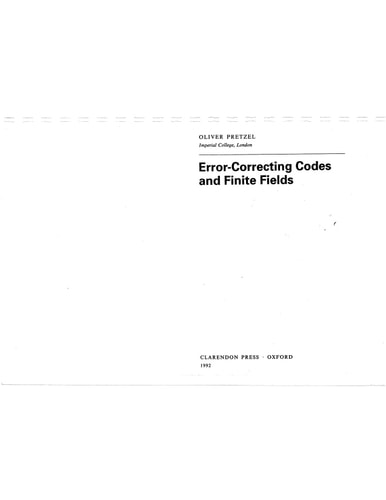
Error-Correcting Codes and Finite Fields
0
0
As an Amazon Associate and affiliate partner, Menrva Books earns from qualifying purchases. Learn more
Author Description
This book provides engineers and computer scientists with all the tools necessary to implement modern error-processing techniques. It assumes only a basic knowledge of linear algebra and develops the mathematical theory in parallel with the codes. Central to the text are worked examples which motivate and explain the theory. The first part introduces the basic ideas of coding theory. The second and third cover the theory of finite fields and give a detailed treatment of BCH and Reed-Solomon codes. The fourth part is devoted to Goppa codes, both classical and geometric, concluding with the Skorobogatov-Vladut error processor. A special feature is a simplified (but rigorous) treatment of the geometry of curves.
Menrva's Summary
THE THESIS
This text investigates the mathematical foundations and practical implementation of error-correcting codes within the context of modern computing and engineering. Oliver Pretzel, drawing upon his expertise in mathematics, constructs a framework that bridges abstract algebraic theory with applied coding techniques. The book utilizes a pedagogical approach, assuming only foundational knowledge of linear algebra to guide the reader through increasingly complex coding systems.
THE SCOPE MAP
What You Will Find
- Comprehensive introduction to basic coding theory concepts
- Theoretical development of finite fields
- Detailed analysis of BCH and Reed-Solomon codes
- Examination of classical and geometric Goppa codes
- Simplified, rigorous treatment of the geometry of curves
Scope Limits
- Requires prior familiarity with basic linear algebra
- Focuses primarily on mathematical theory and specific code structures rather than broad software engineering practices
THE AUTHORITY PERSPECTIVE
Experts and students frequently highlight this text as a clear and accessible entry point for understanding the algebraic underpinnings of error-correcting codes. The inclusion of worked examples is widely cited as a significant aid for those attempting to bridge the gap between abstract theory and practical implementation.
Page Count:
341
Publication Date:
1996-08-29
Publisher:
Oxford University Press
ISBN-10:
0192690671
ISBN-13:
9780192690678
Engineering
Mathematics
Computer Science
Information Theory
Coding Theory
Applied Mathematics