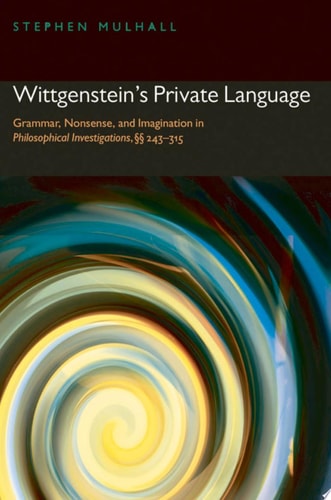
Wittgenstein's Private Language: Grammar, Nonsense, and Imagination in Philosophical Investigations, §§ 243-315
0
0
As an Amazon Associate and affiliate partner, Menrva Books earns from qualifying purchases. Learn more
Author Description
Stephen Mulhall presents a detailed critical commentary on sections 243-315 of Wittgenstein's Philosophical Investigations: the famous remarks on 'private language'. In so doing, he makes detailed use of Stanley Cavell's interpretations of these remarks; and relates disputes about how to interpret this aspect of Wittgenstein's later philosophy to a recent, highly influential controversy about how to interpret Wittgenstein's early text, the Tractatus Logico-Philosophicus, by drawing and testing out a distinction between resolute and substantial understandings of the related notions of grammar, nonsense and the imagination. The book is concerned throughout to elucidate Wittgenstein's philosophical method, and to establish the importance of the form or style of his writing to the proper application of this method.
Menrva's Summary
THE THESIS
This work investigates the philosophical implications of Ludwig Wittgenstein's 'private language' argument within the context of his later writing style and methodology. Stephen Mulhall, a scholar of Wittgenstein and Cavell, provides a rigorous examination of sections 243-315 of Philosophical Investigations. He argues that understanding these specific remarks requires a nuanced grasp of Wittgenstein's broader philosophical method, particularly the relationship between grammar, nonsense, and the role of imagination in philosophical inquiry. By contrasting 'resolute' and 'substantial' interpretations, Mulhall seeks to clarify how the form of Wittgenstein's writing is inseparable from the philosophical conclusions he reaches.
THE SCOPE MAP
What You Will Find
- A detailed commentary on sections 243-315 of Philosophical Investigations.
- An analysis of the 'private language' argument and its implications for philosophy of mind.
- A comparative study of Stanley Cavell's interpretations alongside traditional readings.
- A methodological framework for distinguishing between resolute and substantial understandings of Wittgenstein's work.
THE AUTHORITY PERSPECTIVE
Scholars and students of analytic philosophy frequently cite this text as a vital resource for navigating the complexities of Wittgenstein's later period. Experts highlight the book's ability to bridge the gap between early and late Wittgensteinian thought, noting that the prose is dense and intended for an advanced academic audience.
Page Count:
160
Publication Date:
2008-11-15
Publisher:
Oxford University Press
ISBN-10:
0199556741
ISBN-13:
9780199556748
Philosophy
Academic
Language
Logic
Epistemology
Community Tags
Similar Books