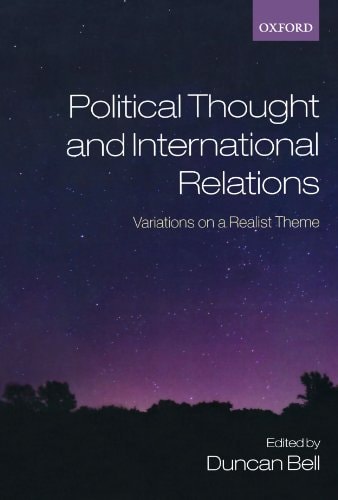
Political Thought and International Relations: Variations on a Realist Theme
0
0
As an Amazon Associate and affiliate partner, Menrva Books earns from qualifying purchases. Learn more
Author Description
Political realism dominated the study of international relations during the Cold War. Since then, however, its fortunes have been mixed: pushed onto the backburner during the 1990s, it has in recent years retuned to the center of scholarly debate in international relations. Yet despite its significance in international relations theory, realism plays little role in contemporary international political theory. It is often associated with a form of crude realpolitik that ignores the role of ethical considerations in political life.Political Thought and International Relations explores an alternative understanding of realism. The contributors view realism chiefly as a diverse and complex mode of political and ethical theorizing rather than either a value-neutral branch of social science or the unreflective defense of the national interest. They analyze a variety of historical and philosophical themes, probing the potential and the pathologies of realist thought. A number of the chapters offer critical interpretations of key figures in the canon of twentieth century realism, including Hans Morgenthau, E. H. Carr, and Reinhold Niebuhr. Others seek to widen the lens through which realism is usually viewed, exploring the writings of Martin Heidegger, Hannah Arendt, and Leo Strauss. Finally, a number of the contributors engage with general issues in political theory, including the meaning and value of pessimism, the relationship between power and ethics, the role of normative political theory, and what might constitute political 'reality.' Straddling international relations and political theory, this book makes a significant contribution to both fields.
Menrva's Summary
THE THESIS
This book investigates whether political realism can be reclaimed as a sophisticated mode of ethical and political theorizing rather than a mere defense of crude realpolitik. Duncan Bell, a prominent scholar in political theory, assembles a collection of essays that challenge the conventional dismissal of realism in contemporary discourse. By examining the historical and philosophical foundations of the realist tradition, the text argues that realism offers a nuanced framework for understanding power, ethics, and the nature of political reality.
THE SCOPE MAP
What You Will Find
- Critical re-evaluations of canonical figures such as Hans Morgenthau, E. H. Carr, and Reinhold Niebuhr.
- Philosophical inquiries into the works of Martin Heidegger, Hannah Arendt, and Leo Strauss.
- Analysis of thematic issues including the role of pessimism, the intersection of power and ethics, and the definition of political reality.
- A bridge between the disciplines of international relations and normative political theory.
THE AUTHORITY PERSPECTIVE
Scholars and students of political theory frequently cite this collection as a vital resource for bridging the gap between international relations and broader political philosophy. Experts highlight the text for its ability to move beyond simplistic definitions of realism, making it a foundational reference for those studying the evolution of twentieth-century political thought.
Page Count:
256
Publication Date:
2011-02-04
Publisher:
Oxford University Press
ISBN-10:
0199556288
ISBN-13:
9780199556281
Philosophy
History
International relations
Realism
Political Theory
Community Tags
Similar Books