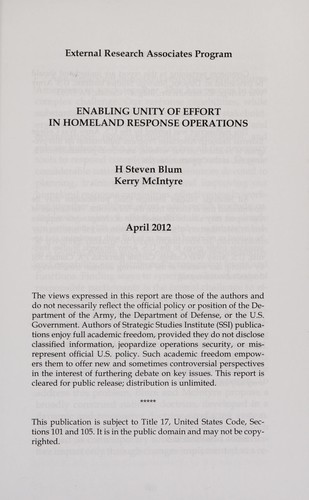
Enabling Unity of Effort in Homeland Response Operations
0
0
As an Amazon Associate and affiliate partner, Menrva Books earns from qualifying purchases. Learn more
Author Description
Any significant homeland response event requires Americans to work together. This is a complex challenge. The authors assert that the principal obstacle to effective homeland response is a recurring failure to achieve unity of effort across a diverse and often chaotic mix of participating federal, state, and local government and nongovernmental organizations. Despite a decade of planning since the terror attacks of September 2001, unity of effort still eludes us -- particularly in the largest and most dangerous of crises. The authors examine how the military's joint doctrine system affected joint military operational capabilities, concluding that a similar national homeland response doctrinal system is needed to create and sustain unity of effort. Doctrine performs a vital unifying function in complex operations, standardizing ways and means. A doctrinal system operates in a dynamic cycle, providing a process to identify capability gaps, develop and validate solutions, and incorporate new concepts into evolving plans and operational capabilities. To implement a dynamic national doctrine, the authors propose a new management concept modeled on the joint interagency task force. They also propose eliminating obstacles to unity of effort within the military, including the temporary employment of any relevant and available military capabilities under the direction of a governor.
Menrva's Summary
THE THESIS
The core problem addressed is the persistent failure to achieve unity of effort in homeland response operations. Despite a decade of planning following the September 2001 attacks, diverse governmental and non-governmental organizations struggle to coordinate effectively during large-scale crises. The authors, drawing on the military's experience with joint doctrine, argue for a similar national homeland response doctrinal system to standardize operations and bridge capability gaps. They propose a management concept based on joint interagency task forces and suggest integrating relevant military capabilities under gubernatorial direction to enhance coordinated response.
THE SCOPE MAP
- Analysis of the principal obstacle to effective homeland response: failure to achieve unity of effort.
- Examination of the military's joint doctrine system and its impact on operational capabilities.
- Argument for a national homeland response doctrinal system to standardize ways and means.
- Description of a dynamic doctrinal system's cycle: identifying gaps, developing solutions, and incorporating new concepts.
- Proposal for a new management concept modeled on the joint interagency task force.
- Suggestion for eliminating obstacles to unity of effort within the military.
- Discussion on the temporary employment of relevant military capabilities under a governor's direction.
THE AUTHORITY PERSPECTIVE
The book examines a critical challenge in national security: achieving coordinated response efforts across disparate agencies during emergencies. The authors' proposal for a national homeland response doctrine, drawing parallels with military joint doctrine, suggests a structured approach to improving interagency cooperation. The proposed management concept, modeled on joint interagency task forces, aims to provide a framework for standardized operations and gap identification. This work likely appeals to policymakers, emergency management professionals, and military strategists interested in enhancing national resilience and response capabilities.
Page Count:
45
Publication Date:
2012-01-01
ISBN-10:
1584875305
ISBN-13:
9781584875307
History
Non-Fiction
Politics
Public Administration
Homeland Security
Government Policy
Community Tags
Similar Books