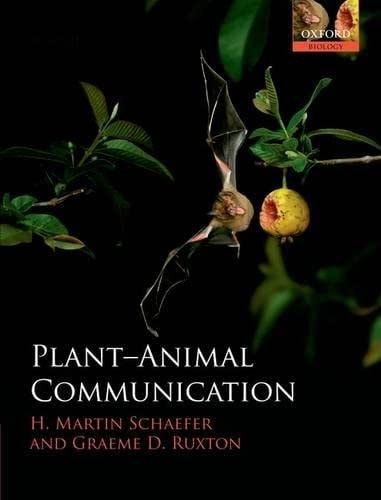
Plant-Animal Communication
0
0
As an Amazon Associate and affiliate partner, Menrva Books earns from qualifying purchases. Learn more
Author Description
Communication is an essential factor underpinning the interactions between species and the structure of their communities. Plant-animal interactions are particularly diverse due to the complex nature of their mutualistic and antagonistic relationships. However the evolution of communication and the underlying mechanisms responsible remain poorly understood.Plant-Animal Communication is a timely summary of the latest research and ideas on the ecological and evolutionary foundations of communication between plants and animals, including discussions of fundamental concepts such as deception, reliability, and camouflage. It introduces how the sensory world of animals shapes the various modes of communication employed, laying out the basics of vision, scent, acoustic, and gustatory communication. Subsequent chapters discuss how plants communicate in these sensory modes to attract animals to facilitate seed dispersal, pollination, and carnivory, and how they communicate to defend themselves against herbivores. Potential avenues for productive theoretical and empirical research are clearly identified, and suggestions for novel empirical approaches to the study of communication in general are outlined.
Menrva's Summary
THE THESIS
This text investigates the evolutionary and ecological mechanisms that govern communication between plants and animals. Authors Graeme D. Ruxton and H. Martin Schaefer, both established experts in behavioral ecology, synthesize current research to explain how mutualistic and antagonistic relationships drive the development of signaling systems. The book provides a theoretical framework for understanding how sensory perception in animals influences the evolution of plant signals, including visual, olfactory, and gustatory cues.
THE SCOPE MAP
What You Will Find
- Analysis of sensory modalities including vision, scent, and acoustic signaling.
- Examination of ecological concepts such as deception, reliability, and camouflage in plant-animal interactions.
- Discussion of functional communication strategies for pollination, seed dispersal, and herbivore defense.
- Identification of future directions for empirical research and theoretical modeling in plant-animal signaling.
THE AUTHORITY PERSPECTIVE
Experts recognize this work as a comprehensive synthesis of the field, effectively bridging the gap between botanical and zoological studies. Readers frequently note the academic density of the prose, which serves as a foundational reference for researchers and advanced students interested in evolutionary ecology.
Page Count:
296
Publication Date:
2011-06-04
Publisher:
Oxford University Press
ISBN-10:
0199563594
ISBN-13:
9780199563593
Science
Biology
Zoology
Evolutionary Biology
Botany
Animal-plant Relationships
Ecology
Community Tags
Similar Books