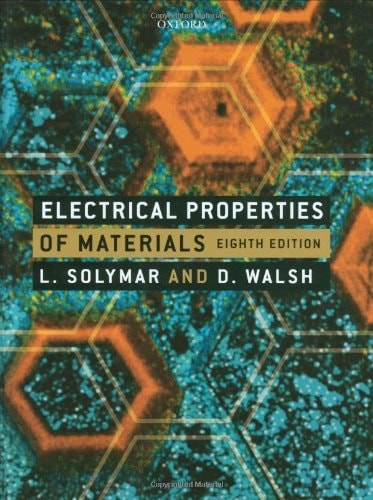
Electrical Properties of Materials
0
0
As an Amazon Associate and affiliate partner, Menrva Books earns from qualifying purchases. Learn more
Author Description
An informal and highly accessible writing style, a simple treatment of mathematics, and clear guide to applications, have made this book a classic text in electrical and electronic engineering. Students will find it both readable and comprehensive. The fundamental ideas relevant to the understanding of the electrical properties of materials are emphasized; in addition, topics are selected in order to explain the operation of devices having applications (or possible future applications) in engineering.The mathematics, kept deliberately to a minimum, is well within the grasp of a second-year student. This is achieved by choosing the simplest model that can display the essential properties of a phenomenom, and then examining the difference between the ideal and the actual behaviour.The whole text is designed as an undergraduate course. However most individual sections are self contained and can be used as background reading in graduate courses, and for interested persons who want to explore advances in microelectronics, lasers, nanotechnology and several other topics that impinge on modern life.To request a copy of the Solutions Manual, visit: http://global.oup.com/uk/academic/physics/admin/solutions
Menrva's Summary
THE THESIS
This text investigates the fundamental physical principles governing the electrical properties of materials and their practical application in modern electronic devices. Authored by experts in the field, the book utilizes a simplified mathematical approach to bridge the gap between theoretical models and real-world engineering behavior. It provides a structured framework for understanding how material properties dictate the performance of components ranging from lasers to nanotechnology.
THE SCOPE MAP
What You Will Find
- Fundamental electrical properties of materials including conductivity, permittivity, and magnetism
- Simplified modeling techniques for analyzing complex physical phenomena
- Comparative analysis between ideal theoretical models and actual device performance
- Applications in microelectronics, laser technology, and nanotechnology
THE AUTHORITY PERSPECTIVE
Experts and educators frequently cite this work as a foundational text for undergraduate electrical engineering students due to its accessible prose and clear pedagogical structure. Readers often note that the self-contained nature of the chapters makes it a useful reference for both academic coursework and independent study in advanced electronics.
Page Count:
443
Publication Date:
2009-12-20
Publisher:
Oxford University Press
ISBN-10:
0199565929
ISBN-13:
9780199565924
Materials
textbook
Physics
Engineering
Electrical Engineering
Community Tags
Similar Books