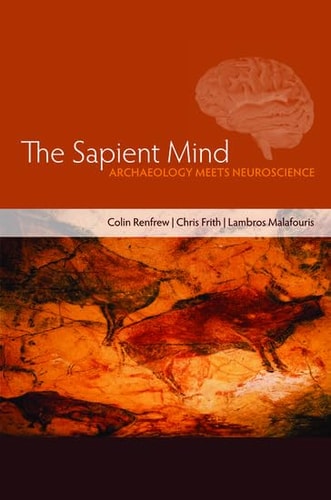
The Sapient Mind: Archaeology Meets Neuroscience
0
0
As an Amazon Associate and affiliate partner, Menrva Books earns from qualifying purchases. Learn more
Author Description
The turn of the twenty-first century has seen a new era in the cognitive and brain sciences that allows us to address the age-old question of what it means to be human from a whole new range of different perspectives. Our knowledge of the workings of the human brain increases day by day and so does our understanding of the extended, distributed, embodied and culturally mediated character of the human mind. The problem is that these major ways of thinking about human cognition and the threads of evidence that they carry with them often seem to diverge, rather than confront one another.The Sapient Mind channels the huge emerging analytic potential of current neuroscientific research in the direction of a common integrated programme targeting the big picture of human cognitive evolution. Up to now, working in isolation, both archaeology and neuroscience have made a number of important contributions to the study of human intelligence. Archaeology, for instance has given us a good idea about where, and an approximate idea about when, Homo sapiens appeared - in Africa somewhere between 100 000 and 200 000 years ago. Neuroscience, on the other hand, has given us a good indication about where in the human brain modern human capacities (e.g. language, symbolic capacity, representational ability, theory of mind (ToM), causal belief, intentionality, sense of selfhood) can be identified and the possible neural networks and cognitive mechanisms that support them. The challenge facing us then is how do we put all these different facets and threads of evidence about the human condition back together again?This book presents the work of leading researchers from archaeology and the brain sciences, showing how a new framework that integrates two hithero isolated disciplines can provide us with a much deeper, more informative, account of where we came from, and why we developed as we did.
Menrva's Summary
THE THESIS
This book investigates how the integration of archaeological evidence and neuroscientific research can provide a unified framework for understanding the evolution of the human mind. The authors, a team of distinguished researchers including Chris Frith and Colin Renfrew, argue that while both disciplines have historically operated in isolation, their convergence is necessary to address the complex nature of human cognition. By synthesizing data on brain function with the material record of human development, the text proposes a multidisciplinary approach to mapping the emergence of modern human capacities.
THE SCOPE MAP
What You Will Find
- Analysis of cognitive mechanisms such as language, symbolic capacity, and theory of mind.
- A framework for reconciling biological brain data with the archaeological record of Homo sapiens.
- Case studies examining the evolution of intentionality and selfhood in early humans.
- Methodological proposals for bridging the gap between brain science and cultural history.
THE AUTHORITY PERSPECTIVE
Experts recognize this work as a significant attempt to bridge the divide between the humanities and the hard sciences. Readers frequently note the academic density of the prose, which serves as a foundational text for those interested in the intersection of cognitive evolution and material culture.
Page Count:
224
Publication Date:
2009-04-15
Publisher:
Oxford University Press
ISBN-10:
0199561990
ISBN-13:
9780199561995
Evolutionary Biology
Neuroscience
Evolutionary Psychology
Archaeology
Anthropology
Community Tags
Similar Books