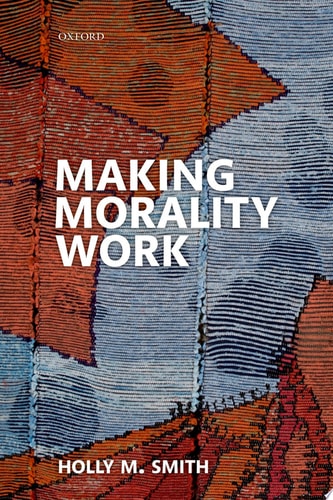
Making Morality Work
0
0
As an Amazon Associate and affiliate partner, Menrva Books earns from qualifying purchases. Learn more
Author Description
Moral theories are called on to play both a theoretical and a practical role. In their theoretical role they provide accounts of what features make actions right or wrong. In their practical role, they provide a standard by which agents can guide their own conduct. Although it is often assumed that a single theory can successfully serve both these roles, in fact the limits on human knowledge often prevent people from using traditional normative theories to make decisions. People suffer from a wealth of impediments to their grasp of facts morally relevant to their choices: they labor under false beliefs, or they are ignorant or uncertain about the circumstances and consequences of their possible actions. An agent so hampered cannot successfully use her chosen moral theory as a decision guide.Holly M. Smith examines three major strategies for addressing this "epistemic problem" in morality. One strategy argues that the epistemic limitations of agents are defects in them but not in the moral theories, which are only required to play the theoretical role. A second strategy holds that the main point of morality is to play the practical role, so that any theory incapable of guiding decisions provides an unacceptable account of right-making features, and must be rejected in favour of a more usable theory. The third strategy claims the correct theory can play both the theoretical and practical role by offering a two tier structure. The top tier plays the theoretical role, while the lower tier provides a coordinated set of user-friendly decision guides that play the practical role. Agents use the theoretical account indirectly to guide their choices by directly utilizing the supplementary decision guides. Smith argues that the first two strategies should be rejected, and develops a detailed novel version of the third strategy that positions us to understand its strengths and shortcomings. Making Morality Work opens a path towards resolving a deep problem of moral life.
Menrva's Summary
THE THESIS
This book investigates the fundamental tension between moral theories as abstract accounts of rightness and their practical utility for agents with limited knowledge. Holly M. Smith, a distinguished philosopher, analyzes the epistemic constraints that prevent individuals from applying traditional normative theories to real-world decision-making. By evaluating three distinct strategies for reconciling theoretical accuracy with practical guidance, Smith argues for a two-tier structure that allows moral theories to function effectively despite human fallibility.
THE SCOPE MAP
What You Will Find
- Analysis of the epistemic problem in moral decision-making
- Evaluation of three primary philosophical strategies for moral guidance
- Development of a two-tier framework for normative ethics
- Examination of the relationship between moral beliefs and factual uncertainty
THE AUTHORITY PERSPECTIVE
Experts in moral philosophy recognize this work as a significant contribution to the debate on normative ethics and decision theory. Readers frequently note the rigorous analytical approach Smith employs to bridge the gap between abstract moral principles and the practical realities of human cognition.
Page Count:
448
Publication Date:
2018-06-26
Publisher:
Oxford University Press
ISBN-10:
0199560080
ISBN-13:
9780199560080
Philosophy
Epistemology
Ethics
Decision Theory
Moral Philosophy
Community Tags
Other Editions(3)
Similar Books





Reader Comments
Share Your Thoughts
No comments yet. Be the first to share your thoughts!