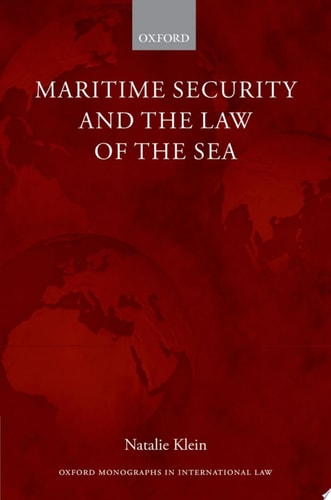
Maritime Security and the Law of the Sea
0
0
As an Amazon Associate and affiliate partner, Menrva Books earns from qualifying purchases. Learn more
Author Description
Maritime Security and the Law of the Sea examines the rights and duties of states across a broad spectrum of maritime security threats. It provides comprehensive coverage of the different dimensions of maritime security in order to assess how responses to maritime security concerns are and should be shaping the law of the sea. The discussion sets out the rules regulating passage of military vessels and military activities at sea, law enforcement activities across the different maritime zones, information sharing and intelligence gathering, as well as armed conflict and naval warfare. In doing so, this book not only addresses traditional security concerns for naval power but also examines responses to contemporary maritime security threats, such as terrorism, weapons of mass destruction, piracy, drug-trafficking, environmental damage and illegal fishing.While the protection of sovereignty and national interests remain fundamental to maritime security and the law of the sea, there is increasing acceptance of a common interest that exists among states when seeking to respond to a variety of modern maritime security threats. This book argues that security interests should be given greater scope in our understanding of the law of the sea in light of the changing dynamics of exclusive and inclusive claims to ocean use. More flexibility may be required in the interpretation and application of the UN Convention on the Law of the Sea if appropriate responses to ensure maritime security are to be allowed.
Menrva's Summary
THE THESIS
This work investigates how the evolving landscape of maritime security threats necessitates a re-evaluation of the interpretation and application of the United Nations Convention on the Law of the Sea. Natalie Klein, a recognized expert in international law, utilizes a comprehensive analysis of state rights and duties to argue that security interests require greater flexibility within existing legal frameworks. By balancing traditional naval sovereignty with contemporary global threats, the text provides a structured argument for adapting international maritime law to modern geopolitical realities.
THE SCOPE MAP
What You Will Find
- Analysis of the legal regulation of military vessel passage and naval activities.
- Examination of law enforcement jurisdictions across various maritime zones.
- Evaluation of responses to modern threats including piracy, terrorism, and environmental degradation.
- Discussion on the tension between exclusive national sovereignty and inclusive common interests in ocean use.
THE AUTHORITY PERSPECTIVE
Legal scholars and practitioners frequently cite this monograph as a foundational text for understanding the intersection of security policy and international maritime law. Experts highlight the rigorous academic density of the prose, noting its utility for those navigating the complexities of the UN Convention on the Law of the Sea.
Page Count:
420
Publication Date:
2011-03-08
Publisher:
Oxford University Press
ISBN-10:
0199566534
ISBN-13:
9780199566532
Law Of The Sea
Law
Security Studies
Professional Career & Trade
International Law
Maritime law
Shipping
Community Tags
Other Editions(4)


Similar Books










Reader Comments
Share Your Thoughts
No comments yet. Be the first to share your thoughts!