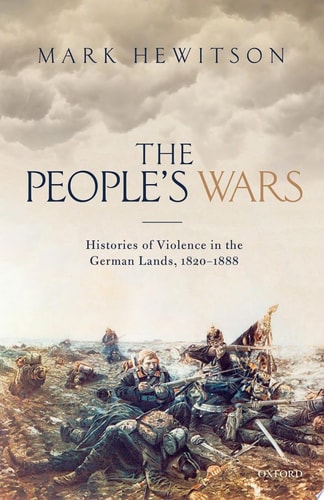
The People's War: Histories of Violence in the German Lands, 1820-1888
0
0
As an Amazon Associate and affiliate partner, Menrva Books earns from qualifying purchases. Learn more
Author Description
How did ministers, journalists, academics, artists, and subjects in the German lands imagine war during the nineteenth century? The Napoleonic Wars had been the bloodiest in Europe's history, directly affecting millions of Germans, yet their long-term consequences on individuals and on 'politics' are still poorly understood. This study makes sense of contemporaries' memories and histories of the Revolutionary and Napoleonic campaigns within a much wider context of press reportage of wars elsewhere in Europe and overseas, debates about military service and the reform of Germany's armies, revolution and counter-revolution, and individuals' experiences of violence and death in their everyday lives. For the majority of the populations of the German states, wars during an era of conscription were not merely a matter of history and memory; rather, they concerned subjects' hopes, fears, and expectations of the future.This is the second volume of Mark Hewitson's study of the violence of war in the German lands during the nineteenth and twentieth centuries. It investigates the complex relationship between military conflicts and the violent acts of individual soldiers. In particular, it considers the contradictory impact of 'pacification' in civilian life and exposure to increasingly destructive technologies of killing during war-time. This contradiction reached its nineteenth-century apogee during the 'wars of unification', leaving an ambiguous imprint on post-war discussions of military conflict.
Menrva's Summary
THE THESIS
This study investigates how German subjects, intellectuals, and political leaders conceptualized and experienced the violence of war throughout the nineteenth century. Mark Hewitson, a scholar of German history, utilizes a vast array of primary sources—including press reports, personal accounts, and political debates—to analyze the intersection of military conflict, conscription, and civilian life. The work argues that the memory of the Napoleonic Wars and the subsequent evolution of military technology fundamentally shaped German expectations of violence and the state's role in managing it.
THE SCOPE MAP
What You Will Find
- Analysis of the cultural and political memory of the Napoleonic Wars in German states.
- Examination of the impact of conscription on civilian hopes, fears, and daily life.
- Investigation into the tension between domestic pacification and the increasing lethality of modern warfare.
- Historical assessment of the 'wars of unification' and their influence on nineteenth-century discourse.
THE AUTHORITY PERSPECTIVE
Experts recognize this work as a significant contribution to the study of German military and social history, particularly for its focus on the subjective experience of violence. Readers frequently note the academic density of the prose and the rigorous archival research that underpins Hewitson's arguments.
Page Count:
512
Publication Date:
2017-04-09
Publisher:
Oxford University Press
ISBN-10:
0199564264
ISBN-13:
9780199564262
History
Germany history
Military History
Nineteenth century
European History
German history
Political History
Community Tags
Similar Books