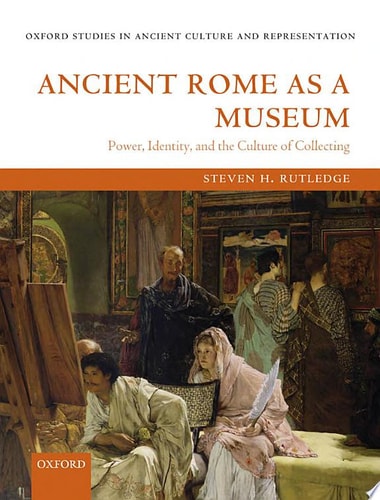
Ancient Rome as a Museum: Power, Identity, and the Culture of Collecting
0
0
As an Amazon Associate and affiliate partner, Menrva Books earns from qualifying purchases. Learn more
Author Description
In antiquity, Rome represented one of the world's great cultural capitals. The city constituted a collective repository for various commemoratives, cultural artefacts, and curiosities, not to mention plunder taken in war, and over its history became what we might call a "museum city." Ancient Rome as a Museum considers how cultural objects and memorabilia both from Rome and its empire came to reflect a specific Roman identity and, in some instances, to even construct or challenge Roman perceptions of power and of the self. In this volume, Rutledge argues that Roman cultural values and identity are indicated in part by what sort of materials Romans deemed worthy of display and how they chose to display, view, and preserve them.Grounded in the growing field of museum studies, this book includes a discussion on private acquisition of cultural property and asks how well the Roman community at large understood the meaning and history behind various objects and memorabilia. Of particular importance was the use of collections by a number of emperors in the further establishment of their legitimacy and authority.Through an examination of specific cultural objects, Rutledge questions how they came to reflect or even perpetuate Roman values and identity.
Menrva's Summary
THE THESIS
This book investigates how the city of Rome functioned as a vast, curated repository of cultural artifacts and how the display of these objects served to construct Roman identity and imperial authority. Steven H. Rutledge, a scholar of Roman history, utilizes the framework of modern museum studies to analyze the Roman practice of collecting, displaying, and preserving items ranging from war plunder to private curiosities. By examining the intersection of material culture and political legitimacy, the author argues that the selection and presentation of objects were deliberate acts that reinforced the values and power structures of the Roman state.
THE SCOPE MAP
What You Will Find
- Analysis of the transition of Rome into a "museum city" through the accumulation of cultural artifacts.
- Examination of the role of private and public collections in shaping Roman social and political identity.
- Case studies on how Roman emperors utilized specific displays to validate their authority and legitimacy.
- Exploration of the public's engagement with and understanding of the historical narratives attached to displayed objects.
THE AUTHORITY PERSPECTIVE
Scholars and historians recognize this work as a significant contribution to the intersection of classical studies and museum theory. Readers frequently note the academic density of the prose, which provides a rigorous examination of how material culture functioned within the Roman imperial framework.
Page Count:
424
Publication Date:
2012-06-18
Publisher:
Oxford University Press
ISBN-10:
0199573239
ISBN-13:
9780199573233
History
Museum Studies
Art Objects
Cultural History
Art History
Archaeology
National Characteristics Roman
Rome
Community Tags
Similar Books