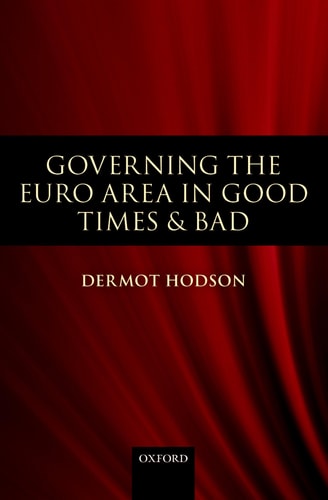
Governing the Euro Area in Good Times and Bad
0
0
As an Amazon Associate and affiliate partner, Menrva Books earns from qualifying purchases. Learn more
Author Description
Can the euro area survive without a more centralized economic policy? What lessons can be drawn from Economic and Monetary Union about new modes of policy-making in the European Union? Have euro area members spoken with one voice on the international stage and what does this mean for the European Union's ambitions to be a global actor in its own right? This book explores these three key questions through an in-depth analysis of euro area governance from the launch of the single currency in 1999 to the sovereign debt crisis of 2010. Drawing insights from the study of European Union politics, comparative political economy and international political economy, it examines: Economic and Monetary Union's break from the Community method of policy-making; the European Central Bank's ambivalence about the pursuit of ever closer union; the Eurogroup's rise and fall as a forum for economic policy coordination; the interplay between national fiscal institutions and the stability and growth pact; the broad economic policy guidelines' failure to apply peer pressure; the European Union's influence within the G20 and the International Monetary Fund at the height of the global financial crisis; euro diplomacy towards China and other rising powers; and current debates about the fate of EMU and the reform of euro area governance in the aftermath of the global financial crisis. The book's conclusions challenge claims that the euro area is in crisis because of its decentralized approach to decision-making alone and the corollary that the euro can be saved only through a further transfer of sovereignty to the supranational level.
Menrva's Summary
THE THESIS
This book investigates whether the euro area requires a more centralized economic policy to survive and what lessons the history of the Economic and Monetary Union offers for future European policy-making. Dermot Hodson, an expert in European Union politics and political economy, utilizes a decade of data spanning from the 1999 launch of the single currency to the 2010 sovereign debt crisis. He challenges the prevailing assumption that decentralization is the sole cause of the euro area's instability, arguing instead for a more nuanced understanding of how national and supranational institutions interact.
THE SCOPE MAP
What You Will Find
- Analysis of the Economic and Monetary Union's departure from traditional Community policy-making methods.
- Examination of the European Central Bank's institutional role and its stance on closer union.
- Evaluation of the Eurogroup's effectiveness as a forum for economic policy coordination.
- Assessment of European influence within global financial institutions like the G20 and the International Monetary Fund.
THE AUTHORITY PERSPECTIVE
Experts recognize this work as a rigorous contribution to the study of comparative political economy and European integration. Readers frequently note the academic density of the prose, which provides a comprehensive framework for understanding the structural challenges facing the euro area.
Page Count:
224
Publication Date:
2011-10-11
Publisher:
Oxford University Press
ISBN-10:
019957250X
ISBN-13:
9780199572502
Economics
International relations
Public Policy
Finance
European Union
Monetary unions
Community Tags
Similar Books