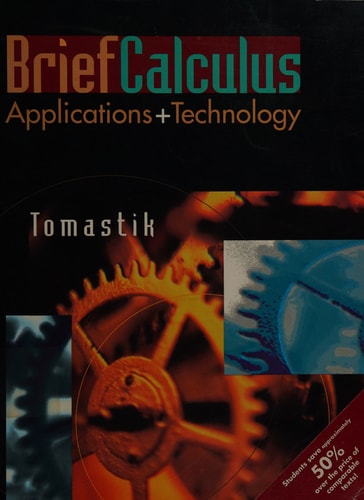
Brief Calculus: Applications + Technology
0
0
As an Amazon Associate and affiliate partner, Menrva Books earns from qualifying purchases. Learn more
Author Description
This text fully embraces the "reform" being called for in calculus teaching and learning. All key concepts are presented following the Rule of Three: from a graphical, numerical, and algebraic viewpoint, encouraging students to visualise, verbalise and write. By always bringing these viewpoints to bear on each topic, the text presents a conceptual understanding of the calculus that is deep and flexible enough to accommodate the many diverse business and science applications presented. The graphing calculator is fully integrated to make these viewpoints and the applications more accessible. Features: * Technology is fully integrated throughout the text and is used to assist the students to think about the geometric and numerical meaning of calculus, without undermining the algebraic aspects. When applicable, examples are demonstrated with graphing calculators. In almost all cases, they represent opportunities for the instructor to have the students reproduce these screens on their graphing calculators, making the student an active partner in the learning process. * Procedures and definitions evolve from the investigation of section-opening applications. These applications are extensive, varied, referenced, and realistic and allow topics to be taught using an investigative, exploratory approach. * Extensive exercises involving writing, exploration, and creativity are given to help students gain better problem-solving skills. Meaningful applications, drawn from a variety of fields, are given for all the mathematics that is presented to motivate the students. Many of the applications are referenced from the modern day journals and articles. * "Explorations", individual or group projects, and writing exercises present students with the opportunity to learn through their own investigations, explore their interests, and increase their communication skills, both inside and outside the classroom.
Menrva's Summary
THE THESIS
This text investigates how the integration of the Rule of Three—graphical, numerical, and algebraic viewpoints—can enhance conceptual understanding in calculus students. Edmond C. Tomastik utilizes his background in mathematics education to construct a framework that prioritizes visualization and verbalization alongside traditional algebraic manipulation. By anchoring mathematical concepts in realistic, application-based scenarios, the author argues that students develop a more flexible and deep comprehension of calculus principles.
THE SCOPE MAP
What You Will Find
- The Rule of Three pedagogical framework for teaching calculus concepts.
- Integration of graphing calculator technology to assist in geometric and numerical analysis.
- Extensive real-world application problems drawn from business and science journals.
- Exploratory projects and writing exercises designed for individual or group work.
Scope Limits
- The text focuses primarily on brief calculus applications rather than exhaustive theoretical proofs.
- The methodology assumes consistent access to and proficiency with graphing calculator technology.
THE AUTHORITY PERSPECTIVE
Educators frequently note that this text serves as a practical resource for instructors aiming to move away from purely rote memorization toward an investigative approach. Experts highlight the book's effectiveness in bridging the gap between abstract mathematical theory and its functional utility in professional fields.
Page Count:
525
Publication Date:
1995-01-01
Publisher:
Holt Rinehart & Winston
ISBN-10:
0030068681
ISBN-13:
9780030068683
Science
Business Mathematics
Education
Reference
Calculus
Science & Math
New Used & Rental Textbooks
Mathematics
textbook
Community Tags
Similar Books