
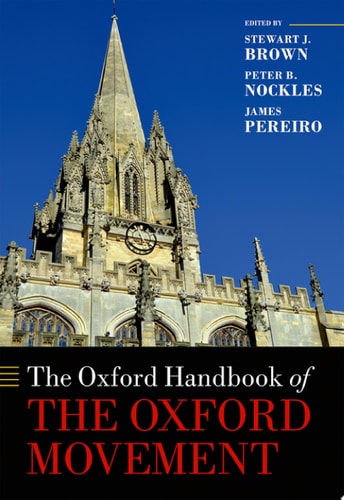
The Oxford Handbook of the Oxford Movement
0
0
As an Amazon Associate and affiliate partner, Menrva Books earns from qualifying purchases. Learn more
Author Description
The Oxford Handbook of the Oxford Movement reflects the rich and diverse nature of scholarship on the Oxford Movement and provides pointers to further study and new lines of enquiry. Part I considers the origins and historical context of the Oxford Movement. These chapters include studies of the legacy of the seventeenth-century 'Caroline Divines' and of the nature and influence of the eighteenth and early nineteenth-century High Church movement within the Church of England. Part II focuses on the beginnings and early years of the Oxford Movement, paying particular attention to the people, the distinctive Oxford context, and the ecclesiastical controversies that inspired the birth of the Movement and its early intellectual and religious expressions. In Part III the theme shifts from early history of the Oxford Movement to its distinctive theological developments. This section analyses Tractarian views of religious knowledge and the notion of "ethos," the distinctive Tractarian views of tradition and development; and Tractarian ecclesiology, including ideas of the via media and the "branch theory" of the Church.The years of crisis for the Oxford Movement between 1841 and 1845, including John Henry Newman's departure from the Church of England, are covered in Part IV. Part V then proceeds to a consideration of the broader cultural expressions and influences of the Oxford Movement. Part VI focuses on the world outside England and examines the profound impact of the Oxford Movement on Churches beyond the English heartland, as well as on the formation of a world-wide Anglicanism. In Part VII, the contributors show how the Oxford Movement remained a vital force in the twentieth century, finding expression in the Anglo-Catholic Congresses and in the Prayer Book Controversy of the 1920s within the Church of England. The Handbook draws to a close, in Part VIII, with a set of more generalized reflections on the impact of the Oxford Movement, including chapters on the judgement of the converts to Roman Catholicism over the Movement's loss of its original character, on the spiritual life and efforts of those who remained within the Anglican Church to keep Tractarian ideas alive, on the engagement of the Movement with Liberal Protestantism and Liberal Catholicism, and on the often contentious historiography of the Oxford Movement which continued to be a source of church party division as late as the centennial commemorations of the Movement in 1933. An "Afterword" chapter assesses the continuing influence of the Oxford Movement in the world Anglican Communion today, with special references to some of the conflicts and controversies that have shaken Anglicanism since the 1960s.
Menrva's Summary
THE THESIS
This volume investigates the historical, theological, and cultural significance of the Oxford Movement within the Church of England and its global legacy. Edited by James Pereiro, Peter Nockles, and Stewart J. Brown, the text compiles scholarly research to evaluate the movement's origins in the nineteenth century, its intellectual framework, and its enduring influence on modern Anglicanism. The contributors utilize primary source analysis and historical documentation to provide a comprehensive overview of the movement's development and its subsequent impact on ecclesiastical controversies.
THE SCOPE MAP
What You Will Find
- Historical context including the influence of seventeenth-century Caroline Divines and the eighteenth-century High Church movement.
- Analysis of Tractarian theology, including concepts of religious knowledge, tradition, and ecclesiology.
- Examination of the movement's global expansion and its role in the formation of worldwide Anglicanism.
- Documentation of the movement's twentieth-century legacy, specifically regarding Anglo-Catholic Congresses and liturgical controversies.
THE AUTHORITY PERSPECTIVE
Experts identify this handbook as a foundational reference for students and scholars of ecclesiastical history. Readers frequently note the academic density of the prose and the comprehensive nature of the research presented by the contributors.
Page Count:
608
Publication Date:
2017-08-01
Publisher:
Oxford University Press
ISBN-10:
0199580189
ISBN-13:
9780199580187
History
Religion
Church History
Theology
Anglicanism
Community Tags
Other Editions(3)
Similar Books

Reader Comments
Share Your Thoughts
No comments yet. Be the first to share your thoughts!