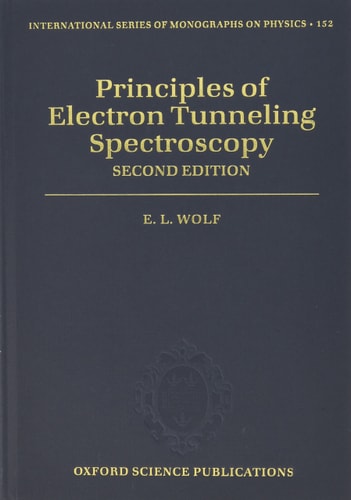
Principles of Electron Tunneling Spectroscopy: Second Edition
0
0
As an Amazon Associate and affiliate partner, Menrva Books earns from qualifying purchases. Learn more
Author Description
Electron tunnelling spectroscopy is a research tool which has strongly advanced understanding of superconductivity. With the invention of the scanning tunneling microscope, STM, by Nobelists G. Binnig and H. Rohrer, beautiful images of atoms, rings of atoms and of exotic states in high temperature superconductors have appeared. Some of the most famous images of any kind, at this date, are STM topographs. This book explains the physics and the instrumentation behind the advances illustrated in the famous images, and summarizes the state of knowledge that has resulted. It presents the current state of the art of tunneling- and scanning tunneling spectroscopies of atoms, molecules and especially superconductors.The first edition of Principles of Electron Tunneling Spectroscopy has been a standard reference for active researchers for many years. This second edition fully embraces the advances represented by the scanning tunnelling microscope and, especially, scanning tunnelling spectroscopy. Stunning images of single atoms and spectral images of impurity states in high temperature superconductors will set this volume apart from its predecessor. The background and current status are provided for applications of Scanning Tunneling Microscopy and Spectroscopy to single atoms and molecules, including determination of bonding energies and vibrational frequencies. The applications to high temperature superconductivity are carefully introduced and the current status is described. A new section covers the astounding advances in instrumentation, which now routinely provide atomic resolution, and, in addition, developments in imaging and image processing, such as Fourier Transform Scanning Tunneling Spectroscopy.
Menrva's Summary
THE THESIS
How does electron tunneling spectroscopy function as a primary analytical tool for investigating atomic structures and superconductivity? E. L. Wolf, a recognized expert in condensed matter physics, synthesizes the theoretical foundations and practical instrumentation required to interpret tunneling phenomena. The text provides a rigorous framework for understanding how scanning tunneling microscopy (STM) and related spectroscopic methods reveal the electronic properties of atoms, molecules, and high-temperature superconductors.
THE SCOPE MAP
What You Will Find
- Theoretical principles of electron tunneling and its application to quantum mechanical systems.
- Detailed analysis of scanning tunneling microscopy (STM) and scanning tunneling spectroscopy (STS) instrumentation.
- Examination of high-temperature superconductivity through spectral imaging and impurity state analysis.
- Methodologies for determining bonding energies, vibrational frequencies, and Fourier transform image processing.
THE AUTHORITY PERSPECTIVE
Experts and researchers in condensed matter physics regard this volume as a foundational reference for both the history and the technical application of tunneling spectroscopy. Readers frequently note the academic density of the prose, which is tailored specifically for active researchers and graduate-level students in the physical sciences.
Page Count:
680
Publication Date:
2012-01-13
Publisher:
Oxford University Press
ISBN-10:
0199589496
ISBN-13:
9780199589494
Science
Physics
Nanotechnology
Spectrum Analysis
Spectroscopy
Community Tags
Similar Books