Law and Gender
0
0
As an Amazon Associate and affiliate partner, Menrva Books earns from qualifying purchases. Learn more
Author Description
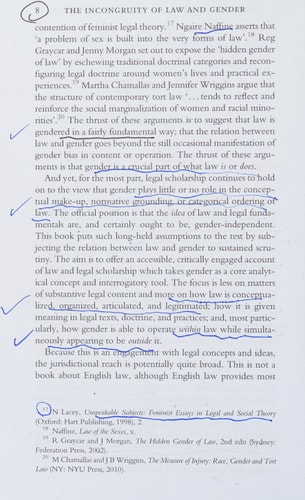
Gender is an increasingly prominent aspect of the contemporary debate and discourse around law. It is curious that gender, while figuring so centrally in the construction and organization of social life, is nevertheless barely visible in the conceptual armoury of law. In the jurisprudential imagination law is gender-less; as a result legal scholarship for the most part continues to hold on to the view that gender plays little or no role in the conceptual make-up, normative grounding, or categorical ordering of law. The official position is that the idea of law and legal fundamentals are, or at least ought to be, gender-independent.This book challenges these long-held assumptions. Exploring the relationship between law and gender it takes gender as a core concept and analytical tool and examines how law is conceptualized, organized, articulated, and legitimated. How can gender be given meaning in legal texts, doctrine, and practices, and how can gender operate within the law while simultaneously appearing to be outside it?The relationship between gender and the law is relevant to virtually all areas of law including in particular criminal law, tort law, family law, employment law, and human rights. Increasingly issues of gender are perceived as the concern of all, reflecting broader debates in the law, including those of equality and sexuality. Covering the key theoretical and substantive areas of jurisprudence, this volume by Joanne Conaghan will be essential reading for all interested in gender studies and legal theory more widely. It offers a clear, concise introduction to gender studies and central feminist concerns for a legal readership.
Menrva's Summary
THE THESIS
This book investigates the persistent invisibility of gender within legal theory and practice, challenging the assumption that law operates as a gender-neutral framework. Joanne Conaghan, a scholar in legal theory, utilizes feminist jurisprudence to deconstruct how gender functions as a core analytical tool in the organization and legitimation of legal systems. By examining the conceptual make-up of law, the author argues that gender is not an external factor but an intrinsic element that shapes legal doctrine, normative grounding, and categorical ordering across multiple fields of practice.
THE SCOPE MAP
What You Will Find
- Analysis of the relationship between gender and core legal areas including criminal, tort, family, and employment law.
- Examination of how gender is articulated and legitimated within legal texts and professional practices.
- Theoretical framework for understanding equality and sexuality within the context of jurisprudence.
- Critical assessment of the 'gender-less' myth in contemporary legal scholarship.
THE AUTHORITY PERSPECTIVE
Experts and legal scholars recognize this volume as a foundational text for those seeking to integrate gender studies into traditional legal education. Readers frequently note the clarity of the prose, which makes complex feminist jurisprudence accessible to students and practitioners alike.
Page Count:
250
Publication Date:
2013-10-01
Publisher:
Oxford University Press
ISBN-10:
0199592926
ISBN-13:
9780199592920
Jurisprudence
Feminist Theory
Sociology
Professional Career & Trade
Law
Sex and law
Gender Studies
Group Identity
Community Tags
Other Editions(4)



Similar Books











Reader Comments
Share Your Thoughts
No comments yet. Be the first to share your thoughts!