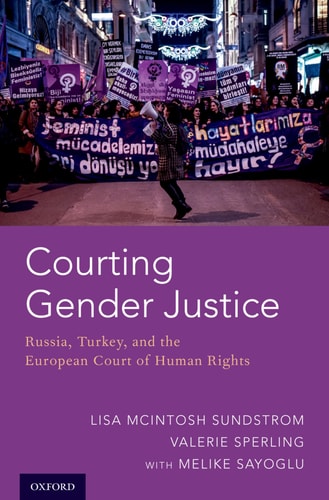
Courting Gender Justice: Russia, Turkey, and the European Court of Human Rights
0
0
As an Amazon Associate and affiliate partner, Menrva Books earns from qualifying purchases. Learn more
Author Description
Women and the LGBT community in Russia and Turkey face pervasive discrimination. Only a small percentage dare to challenge their mistreatment in court. Facing domestic police and judges who often refuse to recognize discrimination, a small minority of activists have exhausted their domestic appeals and then turned to their last hope: the European Court of Human Rights (ECtHR). The ECtHR, located in Strasbourg, France, is widely regarded as the most effective international human rights court in existence. Russian citizens whose rights have been violated at home have brought tens of thousands of cases to the ECtHR over the past two decades. But only one of these cases resulted in a finding of gender discrimination by the ECtHR-and that case was brought by a man. By comparison, the Court has found gender discrimination more frequently in decisions on Turkish cases. Courting Gender Justice explores the obstacles that confront citizens, activists, and lawyers who try to bring gender discrimination cases to court. To shed light on the factors that make rare victories possible in discrimination cases, the book draws comparisons among forms of discrimination faced by women and LGBT people in Russia and Turkey. Based on interviews with human rights and feminist activists and lawyers in Russia and Turkey, this engaging book grounds the law in the personal experiences of individual people fighting to defend their rights.
Menrva's Summary
THE THESIS
This book investigates why gender discrimination cases against Russia and Turkey rarely succeed at the European Court of Human Rights despite the court's reputation for effectiveness. The authors, Lisa McIntosh Sundstrom, Melike Sayoglu, and Valerie Sperling, utilize a comparative framework to analyze the legal and political barriers faced by activists in these two nations. By grounding their research in qualitative interviews with lawyers and human rights advocates, they examine the systemic failures of domestic judicial systems and the specific challenges of litigating gender-based grievances at the international level.
THE SCOPE MAP
What You Will Find
- Comparative analysis of gender and LGBT discrimination litigation in Russia and Turkey.
- Examination of the European Court of Human Rights (ECtHR) procedural and substantive hurdles.
- Qualitative data derived from interviews with feminist activists, human rights lawyers, and legal experts.
Scope Limits
- The study does not provide a comprehensive legal history of all ECtHR rulings.
- It does not offer a universal strategy for winning human rights cases outside of the specific context of gender discrimination in these two nations.
THE AUTHORITY PERSPECTIVE
Experts identify this work as a significant contribution to the study of international human rights law and the practical limitations of supranational courts. Readers frequently note the balance between rigorous academic analysis and the inclusion of personal narratives from those navigating these complex legal systems.
Page Count:
302
Publication Date:
2019-03-01
Publisher:
Oxford University Press
ISBN-10:
019093283X
ISBN-13:
9780190932831
Gender Studies
International relations
Law
Human rights
Sex Discrimination Against Women
Professional Career & Trade
Sociology