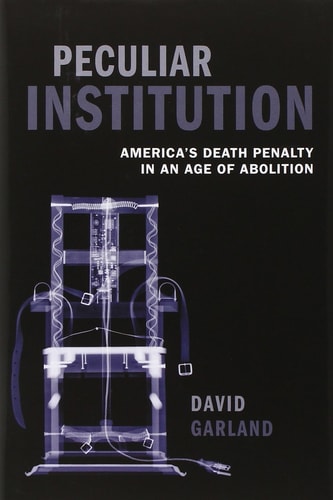
Peculiar Institution: America's Death Penalty in an Age of Abolition
0
0
As an Amazon Associate and affiliate partner, Menrva Books earns from qualifying purchases. Learn more
Author Description
For many Europeans, the persistence of America's death penalty is a stark reminder of American otherness. The practice of state killing is an archaic relic, a hollow symbol that accomplishes nothing but reflects a puritanical, punitive culture - bloodthirsty in its pursuit of retribution. In debating capital punishment, the usual rhetoric points to America's deviance from the western norm: civilized abolition and barbaric retention; 'us' and 'them'. This remarkable new study by a leading social thinker sweeps aside the familiar story and offers a compelling interpretation of the culture of American punishment. It shows that the same forces that led to the death penalty's abolition in Europe once made America a pioneer of reform. That democracy and civilization are not the enemies of capital punishment, though liberalism and humanitarianism are. Making sense of today's differences requires a better understanding of American society and its punishments than the standard rhetoric allows. Taking us deep inside the world of capital punishment, the book offers a detailed picture of a peculiar institution - its cultural meaning and symbolic force for supporters and abolitionists, its place in the landscape of American politics and attitudes to crime, its constitutional status and the legal struggles that define it. Understanding the death penalty requires that we understand how American society is put together - the legacy of racial violence, the structures of social power, and the commitment to radical, local majority rule. Shattering current stereotypes, the book forces us to rethink our understanding of the politics of death and of punishment in America and beyond.
Menrva's Summary
THE THESIS
This work investigates why the United States maintains capital punishment while other Western nations have moved toward abolition. David Garland, a prominent social theorist, utilizes historical analysis and sociological frameworks to argue that the death penalty is not merely a relic of the past, but a functional component of American political culture. He posits that the persistence of this practice is deeply rooted in the nation's specific commitment to local democracy, its history of racial dynamics, and its unique interpretation of liberal governance.
THE SCOPE MAP
What You Will Find
- Historical analysis of penal reform movements in the United States and Europe.
- Examination of the cultural and symbolic significance of capital punishment for both proponents and opponents.
- Investigation into the intersection of constitutional law, local politics, and social power structures.
- Analysis of the influence of racial violence and majoritarian rule on contemporary sentencing practices.
THE AUTHORITY PERSPECTIVE
Scholars and legal experts frequently cite this text as a definitive sociological examination of the American penal system. Readers often note the academic density of the prose, which provides a rigorous alternative to common political rhetoric surrounding the death penalty.
Page Count:
432
Publication Date:
2010-01-01
Publisher:
Belknap Press of Harvard University Press
ISBN-10:
0199594996
ISBN-13:
9780199594993
History
Politics
Social Science
Criminology
Law
Sociology
Community Tags
Similar Books