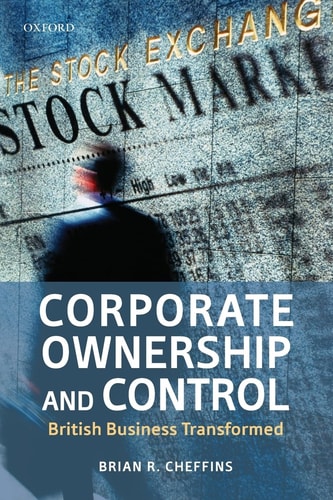
Corporate Ownership and Control: British Business Transformed
0
0
As an Amazon Associate and affiliate partner, Menrva Books earns from qualifying purchases. Learn more
Author Description
The typical British publicly traded company has widely dispersed share ownership and is run by professionally trained managers who collectively own an insufficiently large percentage of shares to dictate the outcome when shareholders vote. This separation of ownership and control has not only dictated the tenor of corporate governance debate in Britain but serves to distinguish the UK from most other countries. Existing theories fail to account adequately for arrangements in the UK. Corporate Ownership and Control accordingly seeks to explain why ownership became divorced from control in major British companies.The book is organized by reference to the 'sell side', which encompasses the factors that might prompt those owning large blocks of shares to exit or accept dilution of their stake, and the 'buy side', which involves factors that motivate investors to buy equities and deter the new shareholders from themselves exercising control. The book's approach is strongly historical in orientation, as it examines how matters evolved from the 17th century right through to today. While a modern-style divorce of ownership and control can be traced back at least as far as mid-19th century railways, the 'outsider/arms-length' system of ownership and control that currently characterizes British corporate governance did not crystallize until the middle of the 20th century. The book brings the story right up to date by showing current arrangements are likely to be durable. Correspondingly, the insights the book offers should remain salient for some time to come.
Menrva's Summary
THE THESIS
This work investigates the historical origins and structural evolution of the separation between ownership and control in British publicly traded companies. Brian R. Cheffins, a legal scholar specializing in corporate governance, utilizes a comprehensive historical framework to analyze why the UK model of dispersed share ownership diverged from international norms. By examining the interplay between the 'sell side' and 'buy side' of equity markets, the author argues that the current system of arms-length corporate governance is a product of long-term institutional development rather than a recent phenomenon.
THE SCOPE MAP
What You Will Find
- Historical analysis of British corporate governance from the 17th century to the present day.
- A dual-framework model examining the 'sell side' factors of share dilution and the 'buy side' motivations of investors.
- Examination of the mid-19th century railway industry as a precursor to modern corporate structures.
- Longitudinal study of the crystallization of the outsider/arms-length ownership system in the mid-20th century.
THE AUTHORITY PERSPECTIVE
Experts recognize this text as a definitive historical account of the British corporate landscape, frequently citing its utility in comparative corporate governance studies. Readers often note the academic rigor and the clarity with which the author connects historical trends to contemporary market durability.
Page Count:
448
Publication Date:
2010-11-05
Publisher:
Oxford University Press
ISBN-10:
0199596395
ISBN-13:
9780199596393
Economics
Business
History
Great Britain
Corporate governance
Finance
Corporate Law
Community Tags
Similar Books