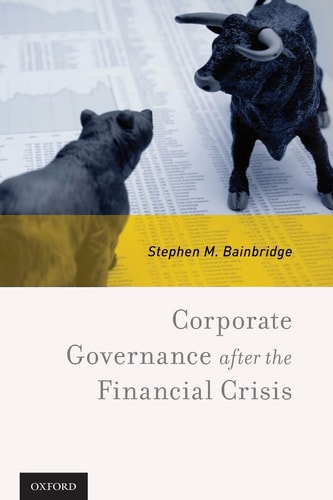
Corporate Governance after the Financial Crisis
0
0
As an Amazon Associate and affiliate partner, Menrva Books earns from qualifying purchases. Learn more
Author Description
The first decade of the new millennium was bookended by two major economic crises. The bursting of the dotcom bubble and the extended bear market of 2000 to 2002 prompted Congress to pass the Sarbanes-Oxley Act, which was directed at core aspects of corporate governance. At the end of the decade came the bursting of the housing bubble, followed by a severe credit crunch, and the worst economic downturn in decades. In response, Congress passed the Dodd-Frank Act, which changed vast swathes of financial regulation. Among these changes were a number of significant corporate governance reforms.Corporate Governance after the Financial Crisis asks two questions about these changes. First, are they a good idea that will improve corporate governance? Second, what do they tell us about the relative merits of the federal government and the states as sources of corporate governance regulation? Traditionally, corporate law was the province of the states. Today, however, the federal government is increasingly engaged in corporate governance regulation. The changes examined in this work provide a series of case studies in which to explore the question of whether federalization will lead to better outcomes. The author analyzes these changes in the context of corporate governance, executive compensation, corporate fraud and disclosure, shareholder activism, corporate democracy, and declining U.S. capital market competitiveness.
Menrva's Summary
THE THESIS
This work investigates whether the post-financial crisis federalization of corporate governance regulation improves corporate outcomes or undermines the traditional state-based regulatory framework. Stephen M. Bainbridge, a professor of law, utilizes a comparative analysis of the Sarbanes-Oxley Act and the Dodd-Frank Act to evaluate the shift from state-level corporate law to federal oversight. He examines the efficacy of these legislative responses in addressing executive compensation, corporate fraud, and shareholder rights. The author argues that the increasing federal involvement in corporate governance warrants a critical assessment of its impact on capital market competitiveness and regulatory efficiency.
THE SCOPE MAP
What You Will Find
- Analysis of the Sarbanes-Oxley Act and the Dodd-Frank Act
- Comparative study of state versus federal regulatory authority
- Evaluation of executive compensation and corporate democracy reforms
- Discussion on U.S. capital market competitiveness
Scope Limits
- Does not provide a comprehensive history of all financial regulations prior to the 2000s
- Does not offer specific investment advice or corporate compliance manuals
THE AUTHORITY PERSPECTIVE
Experts recognize this text as a rigorous examination of the tension between state and federal corporate law in the wake of economic instability. Readers frequently note the academic density of the prose and the author's clear focus on the structural implications of legislative reform.
Page Count:
308
Publication Date:
2016-03-24
Publisher:
Oxford University Press
ISBN-10:
0190496673
ISBN-13:
9780190496678
Economics
Corporate Law
Public Policy
Professional Career & Trade
Finance
Corporate governance
Community Tags
Other Editions(5)

Similar Books





Reader Comments
Share Your Thoughts
No comments yet. Be the first to share your thoughts!