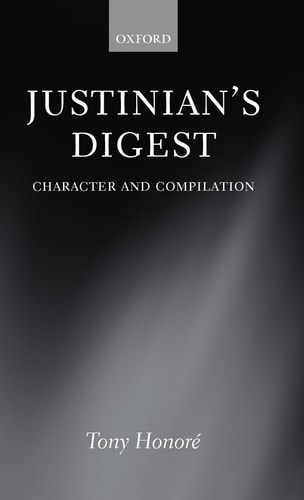
Justinian's Digest: Character and Compilation
0
0
As an Amazon Associate and affiliate partner, Menrva Books earns from qualifying purchases. Learn more
Author Description
This book is a study of the character and compilation of Justinian's Digest, the main volume of Justinian's Corpus Iuris Civilis (528-534 AD). This is often considered as one of the most influential works in the history of Western culture. It remains significant, partly because it is still a part of the law in six countries in Southern Africa, and partly because of its role in the evolution over fifteen hundred years of the theory and practice of human rights - a theme explored in Professor Honore's previous book studying Ulpian (2nd ed, OUP 2002).The book gives a detailed account of the probable methods used in the compilation of the Digest and distinguishes the respective roles of imperial ministers, law professors, and advocates. It also examines the broader issues raised by the Digest's creation - how it was conceived by its compilers, its purpose, and its impact.
Menrva's Summary
THE THESIS
This work investigates the procedural methodology and historical significance behind the compilation of Justinian's Digest, the foundational text of the Corpus Iuris Civilis. Tony Honoré, a distinguished legal scholar, utilizes historical analysis to reconstruct the collaborative efforts of imperial ministers, law professors, and advocates during the sixth century. The text argues that understanding the specific mechanics of this compilation is essential for tracing the long-term evolution of Western legal theory and human rights practices.
THE SCOPE MAP
What You Will Find
- A detailed reconstruction of the administrative and academic methods employed in the creation of the Digest between 528 and 534 AD.
- An analysis of the distinct contributions made by various legal professionals, including ministers and advocates, to the final text.
- An examination of the enduring influence of the Digest on modern legal systems, specifically within Southern Africa.
- A thematic exploration of how the compilers' original intent shaped the subsequent fifteen hundred years of legal practice.
THE AUTHORITY PERSPECTIVE
Legal historians and scholars frequently cite this text as a rigorous examination of Roman jurisprudence and administrative history. Experts highlight the author's meticulous attention to the collaborative nature of the compilation process as a foundational resource for understanding the development of civil law.
Page Count:
256
Publication Date:
2010-09-30
Publisher:
Oxford University Press
ISBN-10:
0199593302
ISBN-13:
9780199593309
History
Non-Fiction
Legal History
Law
Roman Empire
Roman law
Community Tags
Similar Books