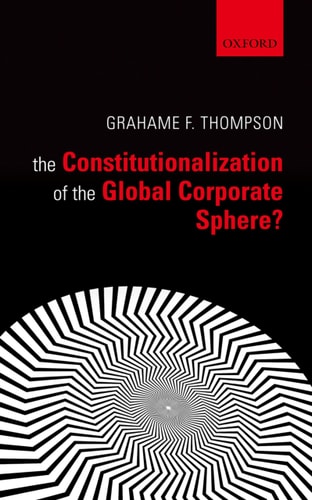
The Constitutionalization of the Global Corporate Sphere
0
0
As an Amazon Associate and affiliate partner, Menrva Books earns from qualifying purchases. Learn more
Author Description
With the advent of globalization--where corporate organizations and the commercial relations that accompany them are argued to be becoming increasingly transnational--the locus of powers, authorities, and responsibilities has shifted to the global level. The nation-state arena is losing its capacity to regulate and control commercial processes and practices as a transformational logic kicks-in, associated with new forms of global rule-making and governance. It is this new arena of global rule-making that can be considered as a surrogate form of global constitutionalization, or "quasi-constitutionalization." But as might be expected, this surrogate process of constitutionalization is not a coherent system or set of rounded outcomes but full of contradictory half-finished currents and projects: an "assemblage" of many disparate advances and often directionless moves--almost an accidental coming together of elements. It is this assemblage that is to be investigated and unbundled by the analysis of the book.The book discusses governance, law, and constitutional matters in the context of international corporate constitutional governance. It examines how and why the business world, commercial relations, and company activities have increasingly become subject to legal and constitutional forms of regulation and governance at the international level. It analyzes how we should characterize the process that has seen the international corporate arena increasingly subject to juridical and constitutional-like regulatory initiatives and interventions and whether this amounts to a new attempt to subject international commercial relations to the "rule of law" and, indeed, to rule the world through these very means.
Menrva's Summary
THE THESIS
This book investigates whether the emergence of transnational corporate governance constitutes a coherent form of global constitutionalization or merely an accidental assemblage of regulatory initiatives. Grahame F. Thompson, an expert in international political economy, examines the shift of regulatory power from the nation-state to the global level. He argues that while commercial relations are increasingly subject to legal frameworks, this process is characterized by contradictory, half-finished projects rather than a unified system of rule-making. The text provides a critical analysis of whether these developments represent a genuine attempt to establish a global rule of law or a fragmented effort to manage international commercial activity.
THE SCOPE MAP
What You Will Find
- Analysis of the transition from national to transnational corporate regulation.
- Examination of quasi-constitutionalization processes in global governance.
- Theoretical framework for understanding the assemblage of disparate international legal initiatives.
- Evaluation of the impact of global rule-making on corporate responsibility and commercial practices.
THE AUTHORITY PERSPECTIVE
Scholars in international law and political economy identify this work as a significant contribution to the study of transnational governance structures. Readers frequently note the academic density of the prose and the author's rigorous approach to deconstructing complex regulatory systems.
Page Count:
200
Publication Date:
2012-12-29
Publisher:
Oxford University Press
ISBN-10:
019959483X
ISBN-13:
9780199594832
Economics
International relations
Corporate governance
Globalization
Law
Community Tags
Similar Books